A hospital tent from Pakistan built for field conditions
A hospital tent has a harder job than most shelters. It must stay dry inside during a cloudburst, stay bearable at midday in June, hold its shape for weeks, and give staff a clean, well-lit floor where they can move between patients. Curiotex makes this hospital tent in Pakistan from 500 gsm waterproof cotton canvas, cut and sewn in our own units in Kasur, where the family business has been producing canvas since 1975.
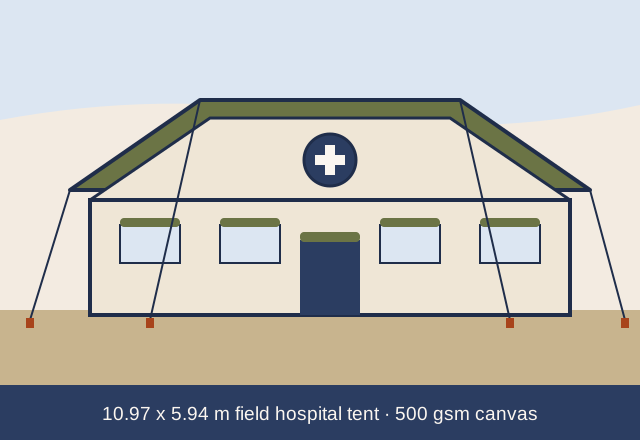
The design follows the long-established general service pattern: 10.97 m long, 5.94 m wide, 1.63 m at the walls and 3.6 m at the centre. That gives roughly 65 m² of covered floor in a single unit, enough for a small ward, a busy outpatient point or a triage station. Armies have used tents of this pattern for decades because they are simple to pitch, easy to repair and interchangeable within a camp, and the same qualities make the tent useful to relief organisations after floods and earthquakes.
We supply the tent; the medical service inside is planned and run by the hospital, army unit or agency that buys it. This page explains the specification, the fly options, practical layout ideas, ventilation, groundsheets and finishes, so that procurement teams can write an accurate order.
Hospital tent specification and dimensions
| Feature | Detail |
|---|---|
| Length | 10.97 m |
| Width | 5.94 m |
| Floor area | Approx. 65 m² |
| Wall height | 1.63 m |
| Centre height | 3.6 m |
| Construction | Single fly or double fly |
| Fabric | Waterproof cotton canvas, 500 gsm |
| Colour | Natural white or custom colour (olive and khaki are common) |
| Groundsheet | Optional: canvas, PE or PVC |
| Supplied with | Metal poles, iron pegs, pins, hammer, cotton carry bag |
| Finishes | Rot-proof, termite-resistant, abrasion-resistant, high-temperature-resistant options |
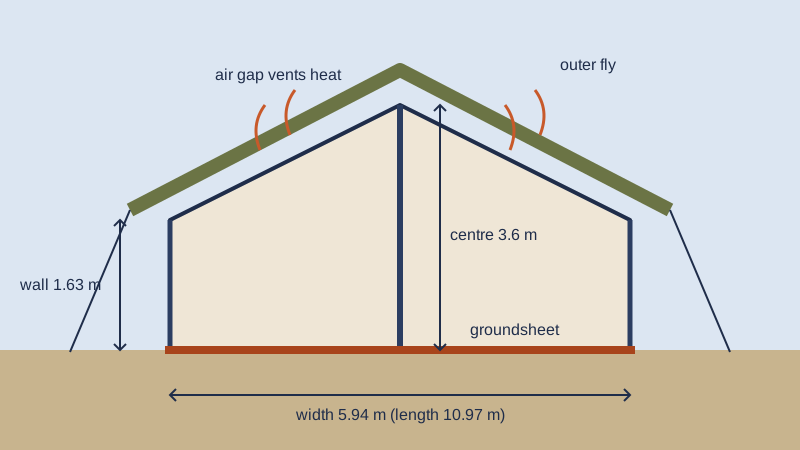
The 3.6 m ridge is high enough for staff to work upright along the centre aisle and for drip stands, screens and hanging lights. The 1.63 m wall lets beds and cupboards sit close to the sides without the roof slope stealing usable floor. If you need more length, several tents can be pitched end to end, and we can discuss joining panels when you send your inquiry.
Relation to the Universal G.S. family
This tent shares its width and heights with the Universal G.S. series, which is also made in Operating (5.48 m), Universal (8.22 m) and Store (13.71 m) lengths. A camp can therefore mix a hospital block with a shorter operating-length tent for administration and a longer store-length tent for supplies, all using the same poles and pitching drill. The full series appears on our marquee tents and military tents pages.
Single fly versus double fly hospital tents
Both versions use the same footprint and the same 500 gsm canvas; the difference is what sits over the roof.
Single fly
One layer of waterproof canvas forms both roof and walls. It is lighter, packs smaller, costs less and goes up faster. It suits mild climates, short deployments and stockpiles where volume and weight in the warehouse matter.
Double fly
A separate outer fly is stretched over the main roof with an air space between them. Direct sun heats the outer layer, not the ceiling above patients, and rain hits a second barrier first. It is the better choice for hot plains, long deployments and heavy monsoon areas.
In Pakistan's summer the inside of a single-skin tent can become oppressively hot by early afternoon. The double fly reduces that load by shading the inner roof and letting hot air escape through the gap. In cold regions the trapped air also gives a little insulation, though serious winter use calls for proper heating and lining planned by the user. If your agency stores tents for unknown future disasters, the double fly is the safer all-climate choice.
Layout ideas: wards, triage and clinics
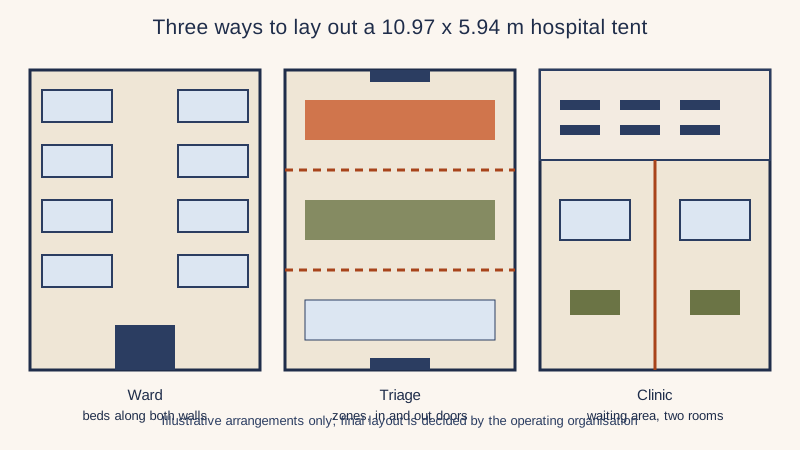
Sixty-five square metres can be arranged in many ways. The ideas below are general space-planning suggestions only; the clinical layout, bed spacing, infection control and staffing are decisions for the medical organisation and should follow its own protocols and any applicable health authority guidance.
Ward arrangement
Beds run along both long walls with their heads to the canvas, leaving the centre aisle under the ridge for staff, trolleys and the tent poles. The door at one end becomes the single entry point, and a small area by the door can be screened off for supplies and hand washing. How many beds fit depends on bed size and the spacing the operator chooses.
Triage arrangement
Rope lines or light partitions divide the length into zones, with patients entering through one end door and leaving through the other. A one-way flow helps keep the area orderly when many people arrive at once after an incident. Rolled-up side windows can give extra exits and light.
Outpatient clinic arrangement
The front third becomes a shaded waiting area with benches, often with the side walls rolled up for air. The rear two thirds are split by a centre partition into two consultation or dressing rooms with their own privacy. Pharmacy and records can sit in a second tent pitched alongside.
Many operators run a group of tents together: a hospital-length tent for patients, a shorter one for administration, and a store tent for medicines and equipment kept off the ground. For a compact first-aid post a smaller frame tent such as the 5 × 5 m dispensary design on our refugee tents page may be enough.
Ventilation and light inside the hospital tent
Fresh air is one of the main comfort factors in any crowded shelter. Cotton canvas helps by breathing, letting water vapour pass out through the weave instead of condensing on the inside as it would under plastic sheeting. That keeps bedding drier and the air less stale.
- Side windows with roll-up flaps can be opened on the leeward side and closed against wind-blown dust or rain.
- Doors at both ends allow cross-ventilation along the length of the tent when opened together.
- The walls can be partly rolled up on hot days so that air moves at bed height.
- The double fly's air gap carries roof heat away before it reaches the interior.
- Natural white canvas reflects more sunlight than dark colours and gives a brighter interior by day.
Tell us your climate and we can suggest the number and position of windows and vents. Extra openings, mesh panels or flap arrangements are made to order. Electrical lighting, fans and cooling equipment are supplied and installed by the user; keep any heaters and generators at a safe distance from the canvas and follow the equipment maker's instructions.
Groundsheet choice and keeping the floor clean
The floor is where a field medical tent most often fails. Bare earth turns to mud, raises dust and is impossible to clean. A groundsheet solves much of this and is strongly advisable for any hospital use. We offer three options:
| Material | Strengths | Best for |
|---|---|---|
| PVC | Heavy, waterproof, can be wiped and washed down | Wards, treatment areas, muddy or flood-affected sites |
| PE (polyethylene) | Light and economical, waterproof | Short deployments, waiting areas, stockpiles |
| Canvas | Breathable, comfortable underfoot, durable | Dry ground, administration tents, longer camps |
For areas where spills are likely, PVC is usually the practical answer because its smooth surface can be washed with water and the cleaning agents chosen by the operator. Raise the site a little and dig drains around it so that rainwater never reaches the groundsheet edge. Canvas walls that have been soiled can be brushed down and washed with plain water; avoid harsh solvents, which may weaken the waterproof finish.
We do not make claims about sterility or medical-grade status for any tent fabric. Cleaning and disinfection procedures, and the suitability of the shelter for particular clinical work, are the responsibility of the medical operator.
Canvas finishes and colour choices
Because we twist, weave, dye and stitch in-house, the canvas can be adapted to the place where the tent will stand. Common requests for hospital tents include:
- Waterproofing – standard on every hospital tent; the cotton swells when wet and the treatment resists penetration.
- Rot-proofing – for humid regions and long periods of contact with damp ground.
- Termite-resistant treatment – useful in parts of Africa and South Asia where termites attack cellulose fabrics.
- Abrasion resistance – for rocky or sandy sites and tents that are moved frequently.
- High-temperature-resistant fabric – where tents stand in strong heat or near hot equipment.
Natural white is the default and gives a bright, cool interior. Armies usually ask for olive green or khaki so the tent blends with other unit equipment; relief agencies sometimes choose a specific colour so that the medical tent is easy to pick out in a camp. Custom colours are dyed in our own dyeing unit for fast shades. Emblems and markings can be discussed, but note that protected humanitarian emblems may only be used by authorised organisations.
Deployment in disasters and military camps
Pakistan's experience of floods, earthquakes and large displacement has shaped how relief teams use field tents. In the first days after a disaster, permanent clinics may be damaged or overwhelmed, and covered space for first aid, vaccination drives, maternal care and outpatient consultations becomes urgent. Pre-positioned hospital tents allow agencies to set up within hours of arriving at a site.
- Choose the site. Pick higher, level ground with road access for ambulances and supply trucks, away from rivers and slopes that could flood or slide.
- Lay out the camp. Mark positions for each tent with room for guy ropes, walkways, drainage and a fire break between rows.
- Prepare the floor. Clear stones and sharp debris, level the ground and spread the groundsheet.
- Pitch the tent. Raise the centre poles and ridge, set the side poles, drive the iron pegs and tension guy ropes evenly. A trained crew can complete one tent in a short session.
- Fit out. Install partitions, beds, lighting and equipment according to the operator's own plan.
- Maintain. Re-tension ropes after rain or wind, check pegs daily in soft ground and dry the canvas before striking the tent.
Military buyers value the general service pattern because it fits standard drills, and parts from one tent fit another. Spare poles, pegs and canvas panels can be ordered with the main consignment so that units can repair their own tents in the field.
Packing, shipping and stockpiling
Each tent is packed by our packing unit with its canvas in a cotton carry bag and its poles and hardware bundled together, so a complete tent arrives as one identifiable set. Packing is marked to match your order references, which helps when consignments are split between warehouses or distribution hubs.
For export we ship by sea container, air freight, charter flight or courier, and within Pakistan by truck. Emergency orders often go by air for the first batch and by sea for the remainder. Our shipment page explains how mode, destination and consignment size affect freight cost.
If tents will be stockpiled, store them dry, off the floor, out of direct sun and away from rodents. Cotton canvas stored correctly keeps well for years; inspect a sample tent from the stock periodically and air it if needed.
How to order hospital tents from Curiotex
To prepare an accurate quotation, tell us the quantity, single or double fly, colour, groundsheet type, any special finishes, extra windows or doors, and the delivery destination. Tender documents and technical drawings are welcome; we can follow your specification or advise where a change might suit the climate better.
Lead time is usually 30 to 45 days from approval of the sample or specification, depending on quantity. New customers pay by sight L/C or 70% advance. Samples are available and normally ship in about two weeks; we can also build a sample to your own design. Defective goods may be returned for repair or replacement.
Contact Haji Ghulam Hasan on +92 317 8885522 or info@curiotex.com, or fill in the Send Inquiry form. For the wider range, see our canvas tents overview and the general purpose and shelter tents.
Hospital tent Pakistan: frequently asked questions
What size is the Curiotex hospital tent?
It measures 10.97 m long and 5.94 m wide, giving about 65 m² of floor. The side walls are 1.63 m high and the centre reaches 3.6 m, so staff can stand upright along the central aisle and beds can sit close to the walls.
What fabric is used?
The tent is made from 500 gsm waterproof cotton canvas, woven, dyed and stitched in our own units. It comes in natural white or a custom colour, and can be given rot-proof, termite-resistant, abrasion-resistant or high-temperature-resistant finishes.
Should I choose single fly or double fly?
Single fly is lighter, cheaper and quicker to pitch, which suits short deployments and mild weather. Double fly adds an outer roof with an air gap that keeps the interior cooler under strong sun and gives extra protection in heavy rain, so it is better for hot regions and longer use.
How many beds fit inside one hospital tent?
That depends on bed size and the spacing your medical team requires, so we do not set a figure. In a typical ward layout beds run along both long walls with an aisle under the ridge. Your organisation should decide spacing according to its own clinical and infection-control protocols.
Which groundsheet is best for medical use?
PVC is usually preferred for wards and treatment areas because it is waterproof and can be washed down. PE is a lighter, economical option for short use or waiting areas, and canvas suits dry ground and administrative tents. All three can be ordered sized to the tent.
Is the tent certified for medical or hospital use?
We manufacture the shelter to the stated specification and do not claim medical certification. Whether a tent is suitable for a particular clinical purpose, and how it is cleaned and equipped, is decided by the operating organisation under the rules that apply where it is used.
What accessories are supplied?
Each hospital tent comes with metal poles, iron pegs, pins, a hammer and a cotton carry bag. Spare poles, pegs and canvas panels can be added to the order, which is useful for army units and agencies that maintain their own tent stock.
Can you add extra windows, doors or partitions?
Yes. Additional windows, mesh panels, roll-up flaps, extra doors and canvas partitions can be made to order. Tell us the planned use and climate in your inquiry and we will suggest positions and sizes.
How quickly can you deliver hospital tents?
Production usually takes 30 to 45 days from approval, depending on quantity. Shipping time then depends on mode: air freight or charter is fastest for urgent relief, sea container is more economical for bulk. See our shipment page.
What payment terms apply to hospital tent orders?
New customers pay by sight L/C or 70% advance. Samples can be supplied first and usually ship in about two weeks, and well-established customers may receive samples at production prices. Minimum order quantities vary by product.