Truck canvas made in Pakistan to fit your vehicle
A truck cover only works if it fits. A sheet that is too small leaves cargo exposed at the tailboard; one that is too large flaps at speed, wears through on the frame and collects water in pockets. That is why Curiotex treats truck canvas in Pakistan as a tailored product rather than an off-the-shelf sheet. We cut and sew each cover to the dimensions or drawings the buyer supplies, using canvas woven, dyed and proofed in our own units in Kasur.
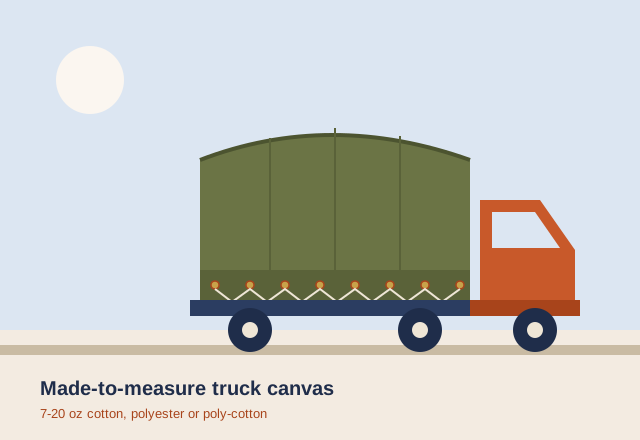
Our covers serve goods trucks, lorries and trailers, military-style and civilian jeeps, and heavy machinery such as generators, compressors and construction plant. Fabric weights run from 7 oz for light, foldable jeep tops up to 20 oz for hard-wearing lorry covers that live outdoors on long-haul routes. The fibre can be 100% cotton, 100% polyester, or a polyester-cotton blend, and every cover is finished waterproof.
We have been making canvas products since 1975, and vehicle covers draw on the same skills as our tents: accurate patterning, strong seams, and fittings placed where the load really pulls. Whether you are a fleet operator, a body builder fitting new trucks, a dealer in vehicle accessories or a procurement office, the process below explains how to specify a cover that will last.
Covers for trucks, lorries, jeeps and machinery
Truck and lorry body covers
Full covers for open goods bodies, either loose sheets that rope down over a load or fitted covers shaped to a hoop or bow frame. Heavier cloth from 14 to 20 oz is typical for long routes, dust and highway wind.
Trailer and container-style covers
Fitted tops and side curtains for flatbed trailers and box-shaped frames, with roll-up or drop-down sides for side loading.
Jeep and utility vehicle tops
Soft tops for jeeps and light utility vehicles, often in lighter 7 to 12 oz cloth so they fold easily, with clear windows, zipped or flap entries and rear drapes.
Heavy machinery covers
Shaped covers for generators, compressors, tractors and plant that stands outside between jobs, keeping rain, dust and sun off engines and control panels.
If your vehicle is unusual, a specialised body, a mobile workshop or a vehicle-mounted equipment set, send photographs and a sketch. Covers for odd shapes are exactly where custom patterning pays off compared with a generic flat tarpaulin.
Truck canvas fabric weights from 7 to 20 oz
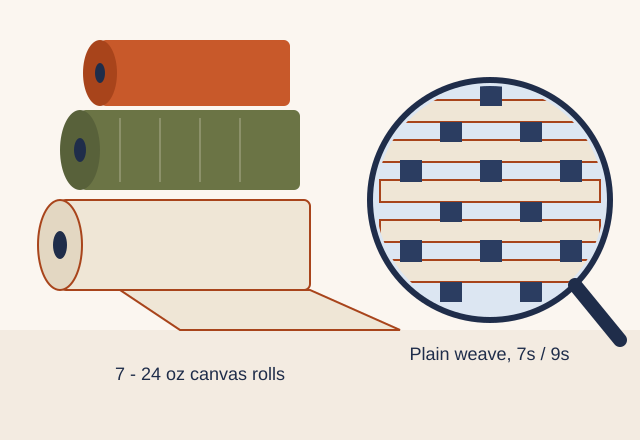
Canvas weight is expressed as ounces per square yard; multiply by about 33.9 for grams per square metre. The right figure balances strength and abrasion resistance against weight and ease of handling. A heavy lorry cover that two people must throw over a load every day is a different job from a machinery cover that stays on for a month.
| Weight | Approx. gsm | Character | Typical vehicle use |
|---|---|---|---|
| 7-9 oz | 237-305 | Light, very foldable | Jeep tops, cab covers, light drapes |
| 10-12 oz | 339-407 | Medium, flexible | Utility vehicle tops, side curtains, small trailers |
| 13-15 oz | 441-508 | Robust all-rounder | Pickup and light truck covers, machinery covers |
| 16-18 oz | 542-610 | Heavy duty | Lorry body covers, long-haul use |
| 19-20 oz | 644-678 | Heaviest | Severe abrasion, rough loads, long outdoor storage |
A useful approach on larger covers is to combine weights: heavier cloth on the roof and at the front where wind and rubbing are worst, lighter cloth on drapes and roll-up sides that are handled most. We can also add extra wear strips along frame contact lines rather than upgrading the whole cover.
Cotton, polyester or poly-cotton: picking the fibre
Each fibre option behaves differently on the road, and the choice affects weight, shrinkage, breathability and service life.
100% cotton canvas
Traditional cotton duck is breathable, quiet in the wind, easy to sew and repair, and grips ropes well. It suits cargo that must not sweat, such as produce, fodder or paper goods. Cotton can shrink slightly after the first heavy wetting, so we allow for that when patterning fitted covers.
100% polyester canvas
Polyester is stronger for its weight, shrinks very little and dries quickly. It holds its shape well on fitted covers and side curtains that must stay taut. It is less breathable than cotton, which is rarely a problem for machinery but worth considering for perishable loads.
Polyester-cotton blend
A blend gives a practical compromise: more strength and dimensional stability than pure cotton, with much of its breathability and soft handle. Many fleet buyers settle on poly-cotton for general goods vehicles.
Not sure which fibre to choose? Tell us the cargo, the route conditions and how often the cover comes off. Advising buyers on the right material is part of our service, and the decision is easier with those three facts in hand.
Fittings: eyelets, ropes, webbing, windows, entryways and drapes
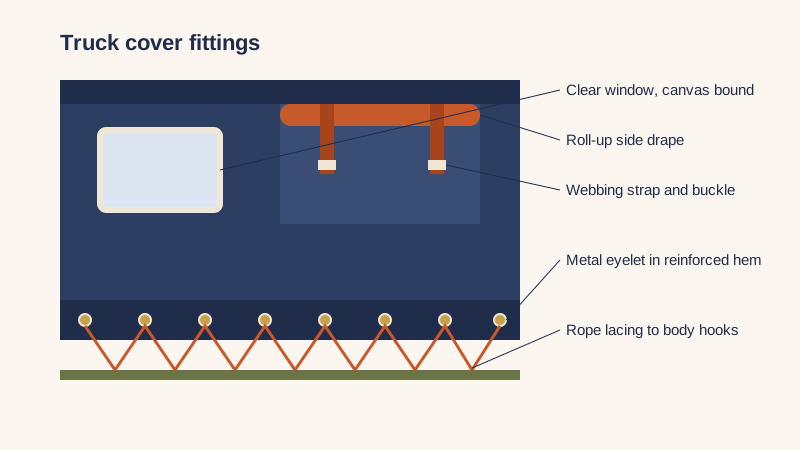
The fabric is only half of a good cover; the fittings decide how it secures, opens and wears. We finish truck canvas with the full range of metal fittings and accessories:
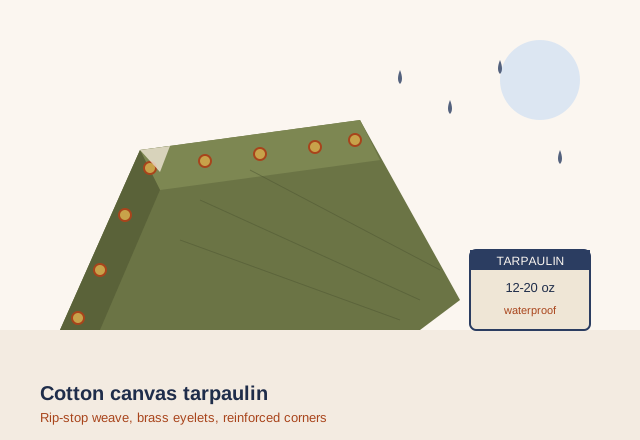
- Metal eyelets set through hems and reinforcing patches, spaced to match your tie rails or hooks.
- Ropes for lacing covers along the body sides and tail, supplied fitted or loose.
- Webbing straps with buckles for quick-release side curtains and fitted machinery covers.
- Windows in clear panels for jeep tops and cab-adjacent covers, framed with canvas binding.
- Entryways with flaps, ties or zips so crews can reach cargo without lifting the whole cover.
- Drapes (curtains) at rear or sides that roll up and tie open for loading.
Where fittings meet the cloth, we sew in additional canvas layers so pulling forces are shared across a broader area. On covers that run over metal bows, we can add sleeves or straps that hold the canvas to the frame and stop it lifting at speed.
How to measure a vehicle for a truck canvas cover
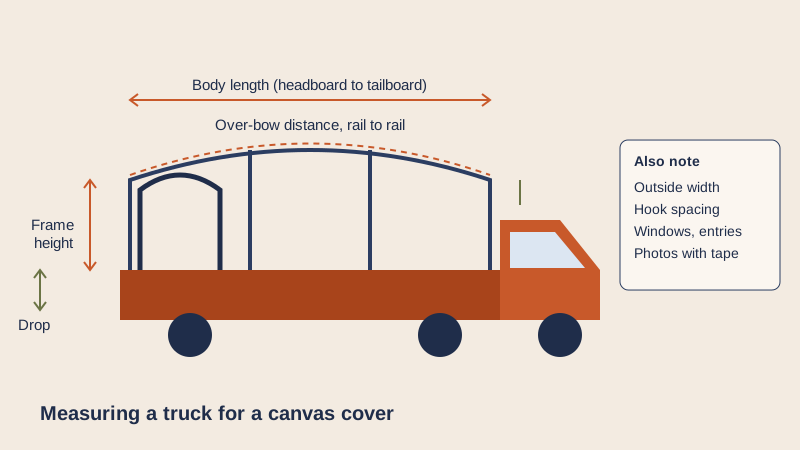
Good measurements save both time and money. For a fitted cover on a bow frame, measure the frame itself, not the old cover, which may have stretched or shrunk. For a loose rope-down sheet, measure the body and decide how far the cloth should hang over the sides.
- Length. Measure the body from the headboard to the tailboard at the top rail.
- Width. Measure across the body outside the side rails.
- Frame height and shape. For hoop frames, measure the height from rail to the top of the bow and over the curve from one side rail to the other with a tape.
- Drop. Decide how far the cover should hang down sides and rear, usually to the rope hooks or a little below.
- Fixing points. Note the position and spacing of hooks or rails so eyelets can be placed to match.
- Openings. Mark where you need windows, entry flaps or roll-up drapes.
Photographs of the body from the front, side and rear, with a tape measure visible, are extremely helpful. For fleets, measuring one representative vehicle carefully and confirming the others are identical is usually enough.
Working from your drawings and samples
Many buyers, particularly body builders and fleet owners, already hold technical drawings for their covers. We work from these directly: send a dimensioned drawing showing panel layout, seam positions, fittings and finishes, and our stitching unit will pattern the cover accordingly. If you only have an old cover that fits well, its dimensions and fitting positions can serve as the reference.
For new designs, we recommend ordering a sample cover first. Samples are generally ready in about two weeks, and we can develop one to your design so it can be tried on the vehicle before bulk production. For well-established customers, samples are offered at production prices. After sample approval, production lead time is typically 30 to 45 days, depending on quantity.
Waterproofing and protective finishes on truck canvas
Every Curiotex truck canvas is finished waterproof. On cotton and blended cloth we use water-repellent treatment that keeps the fabric supple enough to fold and rope down. Rot-proof and mildew-resistant treatments help covers that are often stowed damp. The factory can also produce abrasion-resistant, high-temperature-resistant and termite-proof canvas, useful for covers that sit against hot engine parts, travel desert roads or are stored in warehouses where insects are a concern.
Colour matters on vehicles too. Our dyeing unit produces firm colours that resist fading under strong sun, so a fleet in olive, khaki, navy or a company colour keeps a consistent look. Lighter colours reflect more heat, which can be worth considering for cargo that is sensitive to temperature.
Why choose canvas over plastic sheeting for vehicle covers
Plastic sheets are cheap and light, so it is fair to ask why fleets still pay for canvas. The answer shows up after a few months on the road. Woven canvas resists flapping fatigue far better than film or thin laminates, which crack along folds and split at the eyelets once sun has embrittled them. Canvas also grips its ropes, so lacing stays tight over rough roads instead of sliding loose.
Breathability is the second advantage. Under a plastic sheet, warm days and cold nights produce condensation that drips onto the cargo; a proofed cotton or blended cover lets that vapour escape while still shedding rain. Finally, canvas is repairable in any town with a sewing machine, and a well-maintained cover can be patched and reproofed many times. Over the life of a vehicle, that usually makes canvas the lower-cost choice.
Care and repair of canvas truck covers
Covers last longest when they are dried before folding, rolled rather than crushed, and stored off the ground. Check eyelets and rope lacing regularly; replacing a frayed rope is cheap, while a cover that comes loose at highway speed can tear badly. Pad sharp corners on loads, and keep an eye on the spots where the canvas rubs bows or rails, adding a wear patch early before a hole develops.
Clean with water and a soft brush rather than detergent, which removes proofing. After long service, a reproofing compound restores repellency. Small tears in canvas can be stitched and patched by any competent canvas worker, one of the practical advantages of canvas over coated plastic sheets.
Ordering truck canvas from Pakistan
We supply truck canvas to local Pakistani buyers and to importers abroad, including the Middle East and Africa. Covers are folded, labelled per vehicle type and packed in bales or cartons; shipment can be by sea container, road, air or courier, as explained on our shipment page. Payment terms for new customers are a sight L/C or 70% advance. Minimum order quantities vary with the design.
If you also need loose cloth for your own workshop, our canvas fabric is available in bulk, and standard flat sheets are listed on the tarpaulin page. To start, send measurements or drawings through the inquiry form, email info@curiotex.com, or call +92 317 8885522 and speak to Haji Ghulam Hasan. You are also welcome to visit our Lahore office or read more about Curiotex.
Truck canvas Pakistan: common questions
Which vehicles do you make canvas covers for?
We make covers for goods trucks, lorries and trailers, jeeps and light utility vehicles, and heavy machinery such as generators, compressors and construction plant. Each cover is cut to your measurements or drawings, so unusual bodies and mobile workshops can be covered as well as standard vehicles.
What fabric weight should I choose for a lorry cover?
For lorry body covers used on long routes, 16 to 18 oz canvas is a common choice, with 19 to 20 oz for severe abrasion or rough loads. Lighter 7 to 12 oz cloth is better for jeep tops and side drapes that are folded often. We can also mix weights on one cover.
Is cotton, polyester or poly-cotton better for truck covers?
Cotton breathes and is easy to repair, which suits perishable cargo. Polyester is stronger for its weight and shrinks less, which suits taut fitted covers. Poly-cotton balances the two and is a popular general choice. Tell us the cargo and route and we will recommend one.
Can you make covers from my technical drawings?
Yes. Send a dimensioned drawing showing panels, seams, fittings and openings, and our stitching unit will pattern the cover from it. An old well-fitting cover can also be used as a reference. We suggest approving a sample before bulk production on new designs.
What fittings can be added to a truck canvas?
Standard options are metal eyelets, ropes for lacing, webbing straps with buckles, clear windows, entryways with flaps or zips, and roll-up drapes or curtains. Fittings are backed with extra canvas layers so the load is spread and eyelets do not tear out.
Are the covers waterproof?
All our truck canvas covers are finished waterproof. Rot-proof and mildew-resistant treatments can be added, and the factory can also produce abrasion-resistant, high-temperature-resistant and termite-proof canvas when the vehicle or route requires it.
How should I measure my truck for a fitted cover?
Measure the body length and outside width at the top rails, the frame height and the distance over each bow from rail to rail, then decide how far the cover should drop at sides and rear. Note hook positions and any windows or openings. Photos with a tape visible help a lot.
How long does production take?
Samples usually ship in about two weeks. Bulk production typically takes 30 to 45 days after sample approval, depending on quantity. Shipping time then depends on whether you choose sea, road, air or courier.
What are your payment terms and minimum order?
For new customers we work with a sight L/C or 70% advance. Minimum order quantities vary with the cover design and size, so please share your requirements through the inquiry form and we will confirm.
Can damaged canvas truck covers be repaired?
Yes, one advantage of canvas is that cuts and worn spots can be stitched and patched with matching cloth, and eyelets and ropes replaced. If a delivered cover is defective, it can be returned to us for repair or replacement.