Why school tents matter after a disaster
When floods wash through a district or an earthquake brings down buildings, schools are often among the structures lost or taken over as shelters. Children can then miss months of lessons while repairs wait for funding. School tents give teachers a dry, shaded room within days, and returning to a daily routine of lessons is widely recognised by education and child-protection agencies as one of the most stabilising things a community can offer its children after a crisis.
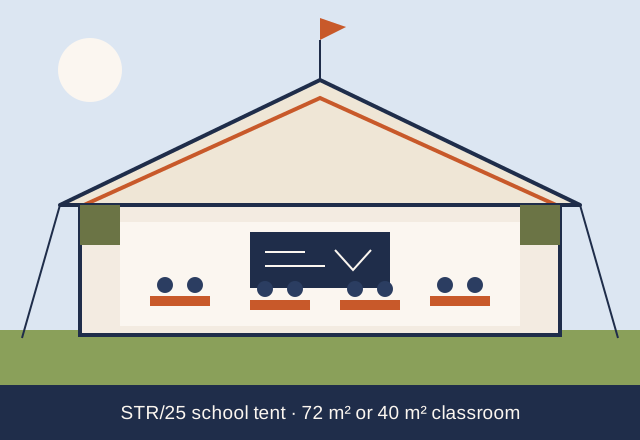
Curiotex, a canvas manufacturer in Kasur since 1975, makes the STR/25 school tent for exactly this purpose: temporary classrooms in disaster rehabilitation, and school camping where large groups need a covered teaching space. The tent is cotton canvas throughout, waterproof and rot-proof, with a double-layer roof and a full cotton lining that make it noticeably calmer and cooler inside than plastic sheeting. Buyers looking for school tents in Pakistan or for export to other emergency-affected regions can order it direct from our factory.
STR/25 school tent specification
The STR/25 is offered in two footprints that share the same heights, materials and construction, so programmes can mix large and small classrooms on one site.
| Item | Specification |
|---|---|
| Sizes | 6 × 12 m (72 m²) and 5 × 8 m (40 m²) |
| Central outer height | 3.38 m |
| Central internal height | 3.30 m |
| Central wall height | 2.0 m |
| Outer fly | Single-fold cotton canvas, 450 g/m² ±10% |
| Inner fly | Two-fold cotton canvas, 450 g/m² ±10% |
| Inner lining | 100% cotton, 170 g/m² |
| Treatment | Waterproof and rot-proof |
| Groundsheet | Polypropylene, laminated on both sides |
| Accessories | Iron poles, metal hammer, iron pins, 9 mm three-strand nylon ropes |
| Shipping weight | 780 kg ±10% |
| Packing | Poles and accessories bundled in polythene, or 3–5 wooden boxes |
The ±10% tolerance on fabric weight and shipping weight reflects normal variation in woven cotton and in packing method. If your tender requires a tighter tolerance or a different fabric weight, include it in the inquiry and we will confirm what can be produced.
Classroom sizes and heights explained
6 × 12 m – the full classroom
At 72 m² the larger STR/25 is close to the floor area of many permanent primary classrooms. Its long rectangular shape lets the teacher stand at one end with a blackboard while pupils sit in rows or groups down the length. It also works as a small assembly hall, library corner or teacher training room.
5 × 8 m – the compact classroom
The 40 m² version suits smaller classes, early-childhood groups, remedial lessons, or sites where flat ground is limited, such as hillside villages or crowded camps. Two compact tents can be quicker to place than one large tent on an awkward plot.
Why the heights matter
A central height of 3.38 m outside and 3.30 m inside leaves generous air volume above pupils' heads, and warm air rises away from them toward the roof. The 2.0 m wall is high enough for adults to stand comfortably right up to the sides, so the whole floor can be used rather than a narrow strip down the middle. That is a real advantage over low ridge tents when 40 or 50 children share a room for several hours a day.
Double-layer construction and lining
The STR/25 is built in layers, each with its own job.
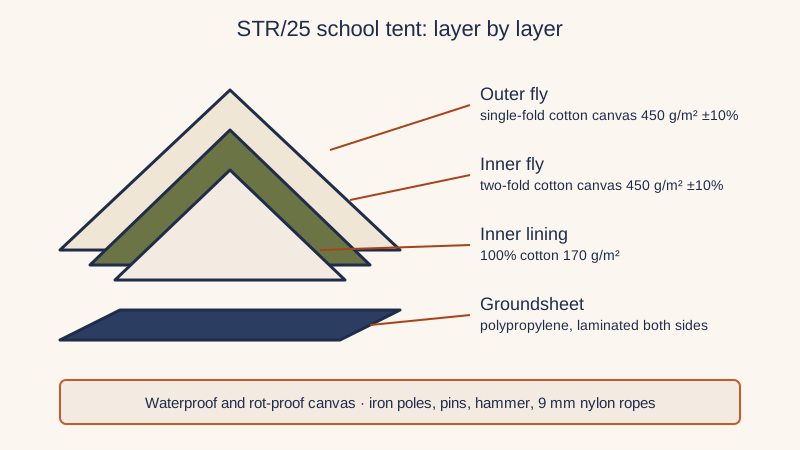
- Outer fly (single-fold, 450 g/m²) takes the direct sun and rain, shedding water and shading the layers beneath.
- Inner fly (two-fold, 450 g/m²) is the main structural tent. "Two-fold" refers to the doubled yarn construction, which gives a stronger, denser cloth.
- Inner lining (100% cotton, 170 g/m²) gives a clean, light-coloured ceiling and walls, softens the interior, and adds a further still-air layer.
- Groundsheet (PP, laminated both sides) keeps damp, dust and insects from rising through the floor.
The air trapped between outer fly and inner fly acts as a buffer. In summer it reduces the heat that radiates down onto pupils; in cooler months it slows heat loss. Cotton canvas also breathes, so the condensation that drips from plastic roofs on cold mornings is far less of a problem. All of the canvas is woven from yarn twisted on our own doubling frames, and dyeing and stitching happen in-house as well, which lets us keep the layers consistent from one tent to the next.
Groundsheet, poles and accessories
Each school tent ships complete, with everything the pitching team needs.
Laminated PP groundsheet
Polypropylene woven sheet laminated on both sides. It is waterproof, tough against scuffing from desks and feet, and easy to sweep. Floor mats or carpets can be laid on top.
Iron poles
Sectional iron poles carry the ridge and walls. They are robust enough for repeated pitching and simple to straighten or replace locally if damaged.
Iron pins and hammer
Iron pins anchor the walls and guy lines; a metal hammer is included so the crew can start work as soon as the bundle is opened.
9 mm nylon ropes
Three-strand nylon guy ropes hold tension well and resist rot. They can be re-tensioned easily after rain or wind.
Programmes running many tents often add spare pins, a few extra pole sections and a repair kit of matching canvas. These cost little at order time and save a lot of trouble in remote locations.
Weight, packing and transport planning
The STR/25 has a shipping weight of about 780 kg ±10%. That figure includes the substantial double-layer canvas, lining, groundsheet, iron poles and accessories, and it is the most important number for logistics officers working out trucks, containers or airlifts.
| Option | Description | Suits |
|---|---|---|
| Polythene bundles | Canvas packed in bales; poles and accessories bundled and wrapped in polythene | Truck delivery, container loads, quick distribution |
| Wooden boxes | The tent and accessories packed into 3–5 wooden boxes | Long sea voyages, multiple handling, warehousing and air freight |
Wooden boxes add cost and some weight but protect poles and canvas when goods will be transhipped, stored in open yards or moved by forklift several times. Polythene bundles are leaner and easier to break down by hand at the destination. Our packing unit marks every package so that the parts of one tent stay together. Shipment options include sea container, air, charter flight, truck and courier; see the shipment page for how we plan delivery.
Because a single STR/25 weighs close to 780 kg, plan unloading at the school site. A small team can manage the bundles by hand, but wooden boxes may need several people or a vehicle with a tail lift.
Classroom layout and capacity guidance
How many pupils a tent can hold is the question we hear most, and the honest answer is that it depends on age, seating type and the standards the education authority or agency follows. The figures below are approximate, general planning ranges and not an official standard.
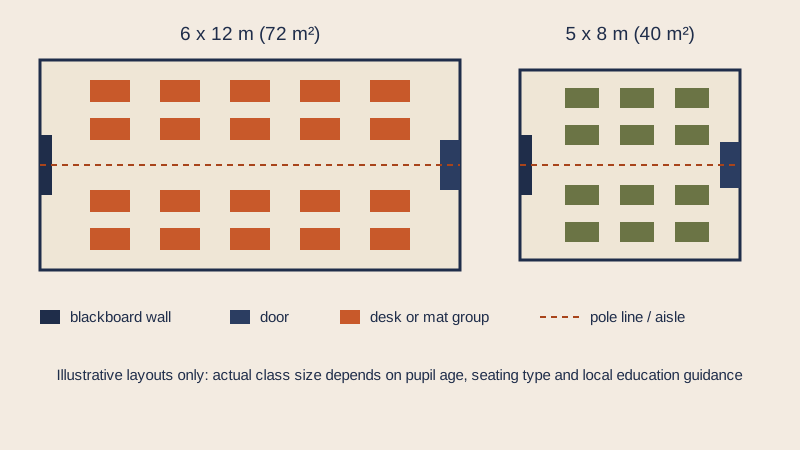
- Many emergency education programmes plan in the region of 1 m² or more per pupil when children sit on floor mats. On that basis the 72 m² tent might hold roughly 50 to 70 young pupils and the 40 m² tent about 30 to 40, after leaving room for the teacher and aisles.
- With desks and benches, allow more space per child, which reduces the numbers to perhaps 40 to 50 and 25 to 30 respectively.
- Older pupils, practical lessons and group work all need more room than rows of young children.
Always check with your education cluster, ministry or donor for the space standard they require. Place the blackboard on an end wall opposite the door so that latecomers do not interrupt the class, keep the central pole line as an aisle, and leave the side windows clear for light. Where shifts are used, one tent can serve a morning and an afternoon class, effectively doubling its capacity over a day.
School tents for education in emergencies
Temporary learning spaces are a standard part of relief programmes after floods, earthquakes and displacement. Beyond lessons, a classroom tent often becomes a place for psychosocial activities, hygiene awareness sessions, vaccination announcements and community meetings. A tall, well-lit canvas room is far more flexible for these uses than a cramped shelter.
- Select safe ground. Choose a level, well-drained site away from rivers, landslide slopes, roads and damaged buildings.
- Prepare the base. Clear stones and debris, level the soil and dig drainage around the footprint.
- Lay the groundsheet and assemble poles. Spread the PP groundsheet and set out the iron poles according to the tent plan.
- Raise the inner fly and lining. Lift the main tent with its lining, then fit the outer fly over it.
- Peg and tension. Drive the iron pins, attach the 9 mm ropes and tension evenly so the canvas sits taut.
- Fit out and handover. Add mats or desks, a blackboard and storage, then brief teachers on airing, re-tensioning and safe use.
Agencies that also need family shelters for the same community can source them from our refugee tents range, and covered space for supplies from the store tent line. For a medical point near the school, see the hospital tent.
School camping, scouting and seasonal use
The STR/25 is not only for emergencies. Schools, colleges and scouting groups use it as a central hall at camps: a dining tent, a rain shelter for activities, or a classroom for outdoor education weeks. The 2.0 m wall and high centre make it comfortable for large groups who would otherwise crowd into small sleeping tents. For the sleeping tents themselves, our camping tents page covers scout and bell tents.
For seasonal use, look after the canvas between camps: dry it completely before storage, keep it off concrete floors, and check ropes and pins at the start of every season.
Care and reuse of school tents between terms
A classroom tent that is looked after can serve several school years, and many programmes move the same tents from one emergency site to the next. Teachers and caretakers are the first line of maintenance, so a short briefing at handover pays off.
- Sweep the PP groundsheet daily and lift mats weekly so that grit does not wear through the laminate.
- Open windows and doors every morning to air the lining, especially after a rainy night.
- Check rope tension after storms; slack canvas lets water pool on the roof and strains the seams.
- Keep cooking fires, heaters and lamps well away from the walls and lining.
- Before striking the tent, let the outer fly and lining dry completely, then fold each layer separately.
When the permanent school building reopens, the dried and repacked STR/25 can go into a district store as part of the preparedness stock for the next flood season. Label each package with the tent size and the date it was last inspected so that it can be dispatched quickly when needed.
Ordering school tents from Curiotex
To quote, we need the size (6 × 12 m or 5 × 8 m), quantity, packing preference (polythene bundles or wooden boxes), colour if other than standard, any tender specification or drawing, and the destination. We can also make variations such as additional windows or a different canvas weight on request.
Typical lead time is 30 to 45 days from approval of the sample or specification, depending on quantity. Payment terms for new customers are sight L/C or 70% advance. Samples usually ship in about two weeks, and minimum order quantities vary by product.
Call +92 317 8885522, email info@curiotex.com and ask for Haji Ghulam Hasan, or use the Send Inquiry form. Our full range of canvas tents is listed on the main tents page.
School tents Pakistan: common questions
What sizes does the STR/25 school tent come in?
Two sizes: 6 × 12 m with 72 m² of floor, and 5 × 8 m with 40 m². Both have a central outer height of 3.38 m, an internal height of 3.30 m and a 2.0 m wall, and both use the same double-layer canvas, lining and groundsheet.
How many children can study in one school tent?
It depends on age, seating and the standard your agency follows. As a rough guide, with floor mats the 72 m² tent may suit about 50 to 70 young pupils and the 40 m² tent about 30 to 40; with desks, fewer. Confirm the space standard with your education authority or cluster.
What fabric is the school tent made from?
The outer fly is single-fold cotton canvas of 450 g/m² ±10%, the inner fly is two-fold cotton canvas of 450 g/m² ±10%, and the inner lining is 100% cotton at 170 g/m². The canvas is waterproof and rot-proof.
What groundsheet is included?
The STR/25 comes with a polypropylene groundsheet laminated on both sides. It is waterproof, resists scuffing from desks and feet, and is easy to sweep clean. Floor mats or carpets can be placed on top for comfort.
How heavy is the tent and how is it packed?
The shipping weight is about 780 kg ±10%. Poles and accessories are either bundled in polythene with the canvas in bales, or the whole tent is packed into 3 to 5 wooden boxes for longer journeys and repeated handling.
Which accessories come with each tent?
Each tent includes iron poles, a metal hammer, iron pins and 9 mm three-strand nylon ropes. We recommend adding spare pins, a few pole sections and matching canvas for repairs if tents are going to remote sites.
Is the tent hot inside during summer?
The double-layer roof leaves an air gap between outer and inner fly that cuts radiant heat, and the cotton canvas breathes, so it is much cooler than plastic shelters. Open the windows and doors for cross-ventilation and roll up wall sections on hot afternoons.
Can the school tent be used for purposes other than classes?
Yes. It works as a community hall, dining tent at school camps, training room, distribution point or activity space. The 2.0 m walls and 3.3 m internal height make the whole floor usable for adults as well as children.
How long does an order take?
Production usually takes 30 to 45 days after approval of the sample or specification, depending on quantity, plus transit time. Samples typically ship in about two weeks. Send details through our inquiry form for a quotation.
Do you ship school tents outside Pakistan?
Yes. We export by sea container, air freight, charter flight and courier, and deliver within Pakistan by truck. Freight cost depends on mode, destination and consignment size. Read more on our shipment page.