Canvas export shipment from Pakistan at a glance
A canvas export shipment is more than a booking with a freight forwarder. Tents, tarpaulins, truck covers and bolts of grey cloth are bulky, heavy and sometimes needed urgently, so the route you choose shapes the landed cost and the date your goods are usable. Curiotex Industries Pakistan has been making canvas goods since 1975, and over those decades our dispatch staff have sent cargo to disaster zones, Gulf importers, West African distributors and buyers at home in Pakistan.
Our approach is simple. The buyer selects the mode that is most feasible for the consignment, whether that is a chartered aircraft, an ocean vessel, a full container, a road truck or an express courier. From that point we take responsibility for preparing, marking, documenting and handing over the goods so they arrive in the time we calculated together when the order was confirmed.
This page walks through each of the five modes in depth, explains how we pack different product families, covers the export paperwork that leaves Pakistan with every lot, and gives a plain-language summary of the trade terms most of our customers use. It does not quote freight rates, because those change weekly with fuel, season and space; ask for a current figure through the inquiry form instead.
Charter flight for urgent relief tents
When an earthquake, flood or displacement crisis strikes, aid agencies cannot wait five weeks for a vessel. A chartered cargo aircraft is the fastest way to move a large quantity of shelter in one lift, and it is the mode most often discussed for emergency refugee and relief tents. The whole aircraft is booked for one consignor, so loading time, routing and destination airfield can be arranged around the response operation rather than a scheduled timetable.
When a charter makes sense
- Life-saving shelter is needed within days, not weeks.
- The destination airport is not well served by regular freighters, or commercial space is full.
- The volume is large enough to fill a substantial share of the aircraft, which spreads the hire cost.
- A relief organisation or donor is funding the lift and has already agreed a landing slot.
Packing for air
Aircraft holds are priced on the greater of actual weight and volumetric weight, so compact packing matters more here than anywhere else. Family ridge tents are rolled tightly with poles and pegs strapped in, then each set is bagged and labelled. We avoid wooden boxes for air lots unless the buyer insists, because timber adds weight without adding much protection for soft goods. Pallet building and netting are done by the airline handling agent at the airport; we deliver the cargo pre-counted and marked so that build-up goes quickly.
Charter costs are high, and the decision normally sits with the agency or government body commissioning the response. Our part is to produce the tents, have them ready at the agreed point, and supply an accurate weight and volume list so the operator can plan the payload.
Ship and sea freight for bulk canvas cargo
Ocean freight is the workhorse of our export business. For heavy, low-value-per-kilo goods such as canvas cloth, ducting cloth and large tarpaulin orders, sea transport usually gives the lowest cost per unit by a wide margin. Pakistan's two main seaports, Karachi Port and Port Qasim, both lie near Karachi on the Arabian Sea coast and connect to Gulf, Red Sea, East African, West African and European services.
Break-bulk and less-than-container lots
Not every sea order fills a box. Smaller consignments can travel as LCL (less than container load), where the forwarder consolidates several shippers' cargo into one container at a container freight station. LCL is charged by cubic metre or tonne, whichever is greater. It suits trial orders of canvas bags or a few hundred tarpaulins, though transit is a little slower because the box must be stuffed and later de-stuffed at a hub.
Typical sea transit
Vessel voyage times vary by carrier and transhipment. Gulf ports are relatively close to Karachi, while West African destinations often involve a transhipment in the Middle East, the Mediterranean or South Asia. We share the forwarder's schedule with you before booking, and we recommend allowing a buffer for port congestion, customs inspection and inland haulage at the receiving end.
Container loading for tents, tarpaulins and fabric
Full container load (FCL) is the preferred option once an order reaches a sensible volume. You rent the whole box, nobody else's cargo shares it, and it is sealed at our premises or the forwarder's yard. Standard choices are the 20-foot and 40-foot dry containers, with the 40-foot high-cube giving extra height for light, bulky goods.
| Product | Usual pack | Limiting factor | Loading tip |
|---|---|---|---|
| Family and relief tents | Rolled tent body plus pole and peg bundle, in bale or bag | Volume | Stack bales tightly; fill gaps with pole bundles |
| Marquee and frame tents | Canvas bales; steel frames in strapped bundles or wooden boxes | Volume and length of poles | Load long steel along the floor first |
| Canvas tarpaulins | Folded, banded bales or cartons | Weight on heavier oz grades | Spread weight evenly across the floor |
| Canvas and polyester fabric | Rolls on tubes or folded bales | Weight | Lay rolls horizontally, interlock rows |
| Canvas bags and thela | Export cartons | Volume | Uniform carton sizes stack to the roof |
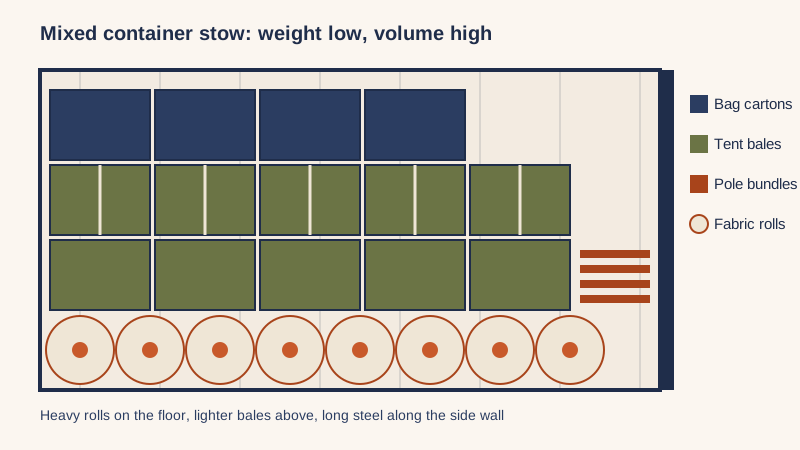
Tents tend to "cube out" — the container fills by volume before it reaches its weight limit — whereas rolls of heavy canvas fabric can "weigh out" with space still free. Mixing the two in one box is a practical way to use both the volume and payload allowance. Our loading supervisors plan the stow so that heavy rolls sit on the floor, softer bales go above, and nothing can shift or crush during the voyage.
Moisture control
Cotton canvas absorbs humidity, and a container crossing from a hot port to a cooler one can "rain" condensation inside. We pack goods dry, use polythene inner wraps where sensible, and can add desiccant bags on request. Buyers shipping during the monsoon months should mention it in the inquiry so we plan extra protection.
Truck transport within Pakistan and across borders
Road haulage covers two very different jobs. The first is domestic delivery: our factory in Kasur and office in Lahore sit in Punjab, and many Pakistani buyers, from construction contractors to government stores, simply want goods trucked to their warehouse. The second is overland export to neighbouring markets, where road transport can be faster and cheaper than routing by sea.
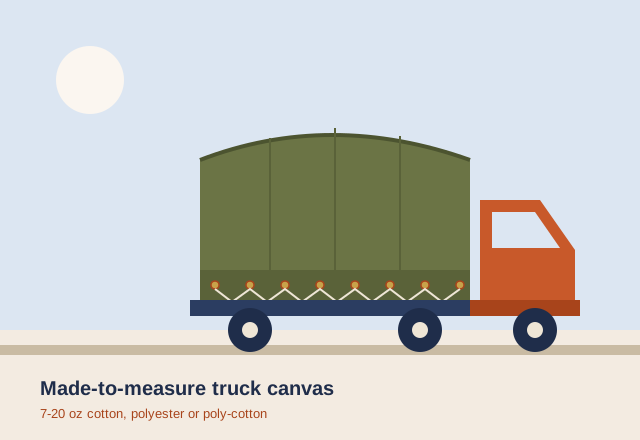
Trucks are also the first leg of almost every export. Even a sea shipment begins with a container or open trailer leaving Kasur for the port at Karachi, a long journey down the country. We make sure loads are covered with heavy tarpaulin, roped and sealed, so goods arrive at the port terminal in the same condition they left the packing hall.
Good fits for road freight
- Domestic orders of truck canvas, tarpaulins and tents for Pakistani customers.
- Cross-border consignments where the importer arranges transit and customs at the frontier.
- Moving goods to an airport for air freight or a charter flight.
Courier for samples and small parcels
International express courier is the right choice for samples, swatch cards, a single demonstration tent or a short run of bags. The parcel is collected from our office, cleared by the courier's own customs brokerage and delivered to the buyer's door, usually with online tracking at every scan. It is the most expensive method per kilogram, which is why we use it almost exclusively for small items.
Samples are the most common courier item we send. A buyer evaluating a new tarpaulin weight, a bag design or a fabric construction can receive a physical piece to test, rather than relying on photos. See our buyer FAQ for how sample timing and charges work.
Export packing: bales, rolls, cartons and wooden boxes
Our packing unit is a dedicated part of the factory, because the way goods are packed affects both their condition on arrival and what you pay in freight. Each format has its place.
Bales
Folded canvas or tents compressed and bound with straps, then wrapped in hessian, polypropylene or polythene. Bales are dense, cheap to make and easy to handle with a forklift or by hand.
Rolls
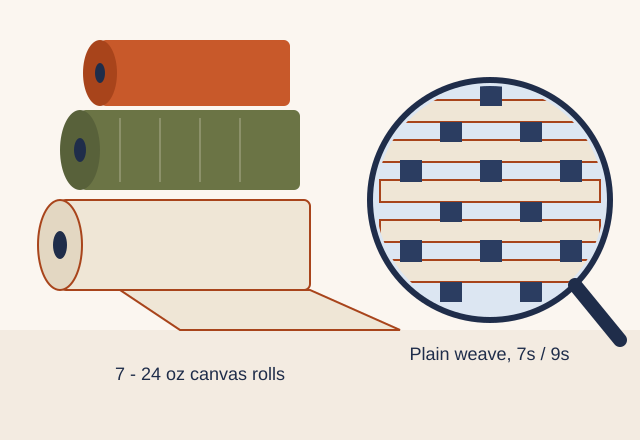
Fabric wound on a cardboard or plastic core, wrapped in film and labelled with length, width, construction and lot number. Rolls protect the cloth surface from creasing.
Cartons
Corrugated export cartons suit bags, small tarps and accessories. Uniform cartons stack neatly and are easy to count at customs.
Wooden boxes
Used for poles, hammers, pins and fittings, especially on heavy tents such as the school tent, which can be packed in three to five boxes. Export timber normally needs heat treatment under ISPM 15.
Every package carries shipping marks: consignee name or code, destination port, order number, package number out of total, and gross and net weight. Clear marks let receiving warehouses check the count quickly and match each package to the packing list.
Export documents for every canvas export shipment
Goods leaving Pakistan need a set of documents for customs clearance at origin and for the importer to clear at destination and, where applicable, to collect payment under a letter of credit. The core set looks like this:
- Commercial invoice — describes the goods, quantity, unit price, total value, Incoterm and payment terms. It is the basis for customs valuation at both ends.
- Packing list — itemises each package with contents, dimensions and weights, so customs officers and warehouse staff can verify the consignment.
- Bill of lading or airway bill — the transport document issued by the carrier. A sea bill of lading is also a document of title, which is why banks hold it under L/C transactions; an airway bill is a receipt and contract of carriage.
- Certificate of origin — confirms the goods were made in Pakistan. Importers may need it for duty treatment or to satisfy local rules.
- Additional papers when requested — such as an insurance certificate under CIF, fumigation or heat-treatment certificates for timber packing, or inspection reports if the buyer appoints a third-party inspector.
If you pay by letter of credit, send us the draft L/C before it is issued. Small mismatches between L/C wording and shipping documents, such as a misspelt port name, are a common cause of payment delays, and they are far easier to fix at the draft stage.
Incoterms for canvas exports: EXW, FOB, CFR and CIF
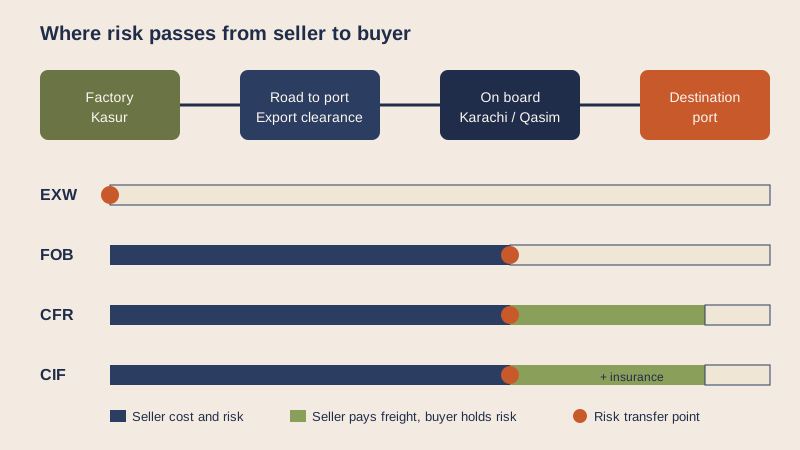
Incoterms are standard trade terms published by the International Chamber of Commerce. They define where responsibility and risk pass from seller to buyer, and who pays which costs. Our customers mostly use four of them.
| Term | Seller arranges | Risk passes to buyer | Suits |
|---|---|---|---|
| EXW (Ex Works, Kasur) | Goods ready at the factory | At our premises | Buyers with their own Pakistani forwarder |
| FOB Karachi / Port Qasim | Inland haulage, export clearance, loading on board | Once goods are on board the vessel | Importers who book their own ocean freight |
| CFR | Everything in FOB plus ocean freight to destination port | On board at the Pakistani port | Buyers who want one price to their port and insure locally |
| CIF | CFR plus minimum marine insurance | On board at the Pakistani port | Buyers or banks requiring insurance cover from the seller |
Note that under CFR and CIF, the seller pays freight to the destination, but the risk still transfers in Pakistan when the goods are loaded. That is a frequent point of confusion. For air shipments the equivalent "any mode" terms, such as FCA, CPT and CIP, are more technically correct, and we can quote on those as well. Tell us in your inquiry which term you prefer and we will price accordingly.
Cargo insurance, tracking and delivery timelines
Insurance
Marine cargo insurance protects against loss or damage in transit. Under CIF, the seller must buy at least the minimum cover required by the Incoterms rules; many buyers prefer broader "all risks" cover, which they can request or arrange themselves under FOB or CFR. Relief agencies and large importers often have annual open cover policies, in which case they only need us to provide shipment details for declaration.
Tracking
Once goods are handed to the carrier we send copies of the transport document and the container, flight or tracking number. Container lines and couriers offer online tracking, and your forwarder can give vessel position updates. We also keep you informed of milestones on our side: production finished, inspection done, goods loaded, documents couriered.
Building a realistic timeline
Total time from order to arrival combines production and transit. Production lead time is usually 30 to 45 days from product approval, depending on quantity. Add the inland move to port, the vessel or flight schedule, transit time, and clearance at destination. For tents needed before winter, such as winterized family tents, we suggest working backwards from the date they must be pitched and placing the order with enough margin for every leg.
Choosing the right mode for your shipment
There is no single best route; it depends on urgency, volume and budget. As a rough guide: courier for samples and parcels; air or charter flight when speed outweighs cost; LCL for modest sea orders; FCL once you can fill a box; and trucks for domestic delivery and the first leg to any port. Our team will talk through the options with you and, when helpful, introduce a forwarder familiar with your destination.
Ready to plan a consignment of canvas tents, tarpaulins or fabric? Send an inquiry with your quantity, destination port and preferred Incoterm and we will come back with a quotation that fits.
Questions about canvas export shipment
Which shipping modes can Curiotex arrange for canvas goods?
We work with five: charter flight, ship (sea freight), container (FCL or LCL), truck and international courier. The buyer chooses the most feasible mode for the consignment, and our dispatch team then takes care of packing, marking, documents and hand-over to the carrier so the goods arrive in the agreed time.
Can you give me a freight rate on the website?
No. Freight charges depend on the mode, destination, consignment size and the market rate on the day of booking, and they change often. Send your quantity, destination port or airport and preferred Incoterm through the inquiry form and we will return a current figure with your quotation.
From which port do your sea shipments leave?
Sea cargo from our Kasur factory is trucked south to Karachi Port or Port Qasim, the two main seaports of Pakistan. FOB quotations normally name one of these. If your forwarder prefers a particular terminal or line, tell us and we will deliver the goods there.
How many tents fit in a 40-foot container?
It depends on the tent model, fabric weight, whether flysheets, inner tents and groundsheets are included, and how poles are packed. Tents usually fill a container by volume before weight. Share the exact model and options you need and we will calculate a container loading figure for your quotation.
Do you ship on FOB, CFR, CIF or EXW terms?
Yes, all four. EXW suits buyers with their own local forwarder, FOB Karachi or Port Qasim suits importers who book their own vessel, and CFR or CIF give a delivered-to-port price. For air cargo we can also quote FCA, CPT or CIP.
Which documents come with an export consignment?
The standard set is a commercial invoice, packing list, bill of lading or airway bill and certificate of origin. Insurance certificates, heat-treatment certificates for wooden boxes, or third-party inspection reports can be added when your bank, L/C or local customs requires them.
Is cargo insurance included?
Under CIF or CIP we include insurance in the price. Under EXW, FOB or CFR the buyer normally insures the goods, which lets you choose the cover level and insurer. Agencies with an open cover policy only need us to share the shipment details.
How are tents packed for export?
Tent bodies are rolled or folded into bales or carry bags, with poles, pegs and accessories bundled or boxed alongside. Heavier tents can have fittings packed in wooden boxes. Each package is marked with order number, package count and weights so the receiving warehouse can check it quickly.
How long does a full order take to reach me?
Production usually takes 30 to 45 days after product approval, depending on quantity. Transit then depends on the mode and route. We share an estimated schedule when you confirm and keep you updated at each milestone, but please plan a buffer for port and customs time at destination.