Why our canvas manufacturing units sit under one roof
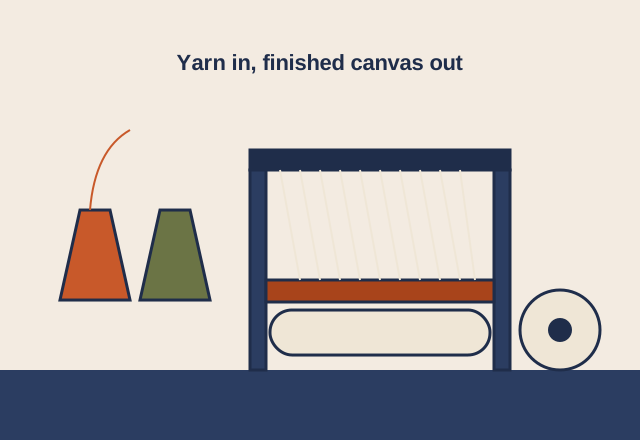
A canvas tent is the end of a long chain. Yarn has to be twisted to the right strength, woven to the right density, coloured so it does not fade, sewn so the seams do not leak and packed so nothing is missing on arrival. In many supply chains, each of those steps belongs to a different company. At Curiotex Industries Pakistan, all five belong to us. We call them the Curio Units, and together they form the canvas manufacturing units that stand behind every product on our catalogue.
This page explains what each unit does, how work moves between them, where we check quality, and why that arrangement benefits buyers who need dependable canvas in volume. It is written for procurement teams, technical reviewers and importers who want to understand how their goods are made before they commit to an order.
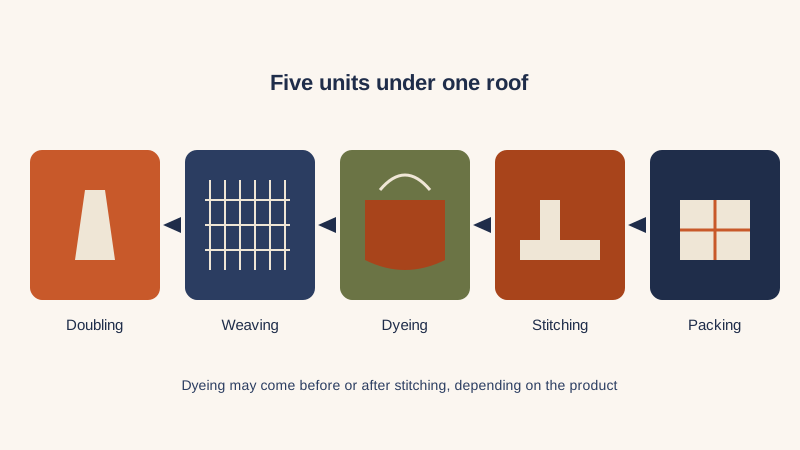
Doubling unit: preparing yarn with the right twist
Canvas strength begins with the yarn. Single cotton yarns are relatively weak and hairy; twisting two or more of them together, a process known as doubling or plying, produces a rounder, stronger and more even thread. That plied yarn resists abrasion better, weaves more cleanly and gives the finished cloth a firmer hand.
We run our own doubling frames, which means the twist level is set by us to suit each fabric rather than accepted from whatever a yarn supplier happens to stock. A higher twist can improve strength and water resistance for heavy tent canvas, while a slightly softer twist may suit fabric meant for bags or sheeting. The result, in every case, is well-twisted yarn ready for the looms.
What the doubling unit controls
- Ply count and twist per unit length, matched to the fabric being woven.
- Consistency between packages, so the weaving unit receives uniform yarn.
- Removal of weak or uneven sections before they become faults in the cloth.
Our raw yarn is purchased locally in Pakistan, which keeps lead times short and allows us to switch counts quickly when a specification changes.
Weaving unit: turning yarn into heavy canvas
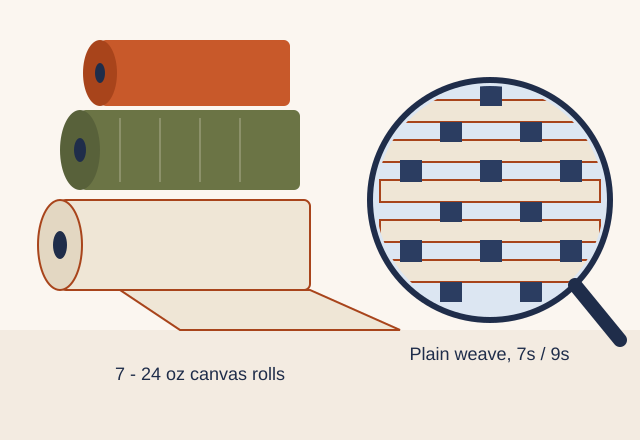
The weaving unit is the heart of the factory. Here prepared warp yarns are set on the looms and interlaced with weft yarns to form canvas. Most of our cloth uses 7s and 9s count yarn in plain weave, with twill, drill and denim structures for particular products. Fabric weights range from light camping canvas around 270 gsm to 600 gsm store tent cloth and up to 24 oz plain canvas.
Experienced supervisors run the weaving floor. Their job is to balance two goals that can pull against each other: output and quality. A loom running too fast or with poor tension produces loose picks, broken ends and uneven weight. By keeping machines tuned and operators trained, the unit has been able to raise production while holding the fabric to specification.
Weaving decisions that affect your product
Ends and picks
The number of warp and weft threads per inch decides how tight the canvas is, which in turn affects water resistance and tear strength.
Width
Cloth width determines how many seams a tent roof or tarp will need. Fewer seams generally mean fewer potential leak points.
Construction
Plain weave gives a firm, flat surface; drill and twill add drape and strength; rip-stop yarns limit tear spread in tarps.
Greige fabric leaving the looms is weighed and measured before it moves on, so that a roll intended for 450 gsm tents is not sent to the stitching floor if it comes off light.
Dyeing and finishing unit: firm colours and protective treatments
Colour matters more for canvas than many buyers expect. Military tents need olive green that matches previous deliveries; relief agencies may specify natural white or a particular shade so shelters can be recognised in a camp; event tents need stripes or bright colours that stay attractive after a season in the sun. A colour that fades or bleeds makes a product look old and, in some contracts, can lead to rejection.
Our dyeing unit uses techniques developed in-house over many years to produce firm, fast colours on heavy cotton. Because the recipes are ours, we can repeat a shade for a follow-on order and adjust it when a buyer supplies a new standard.
Finishing treatments
The same area handles the treatments that turn raw canvas into weatherproof material. Depending on the order, cloth can be made waterproof or water-impregnated, rot-proof, termite-proof, abrasion resistant or resistant to high temperatures. Tarpaulin canvas can alternatively be wax coated. These finishes are applied to the whole width of fabric before cutting, which gives more even protection than treating a finished item.
Dyeing and finishing usually happen before stitching, although some products are dyed or treated at a different point when the design calls for it. Either way, the colour and finish are checked against the approved sample before cutting begins.
Stitching unit: from fabric to tents, tarps and bags
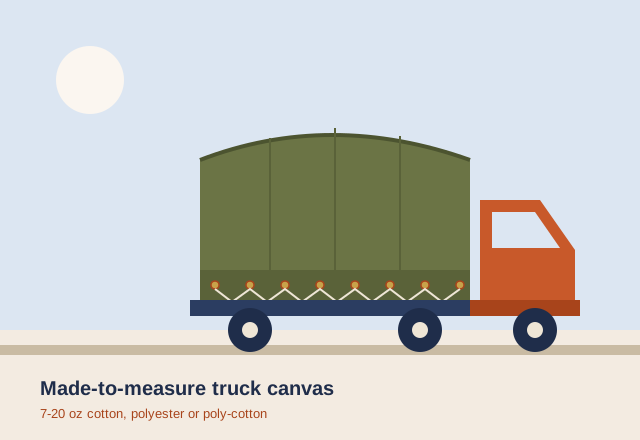
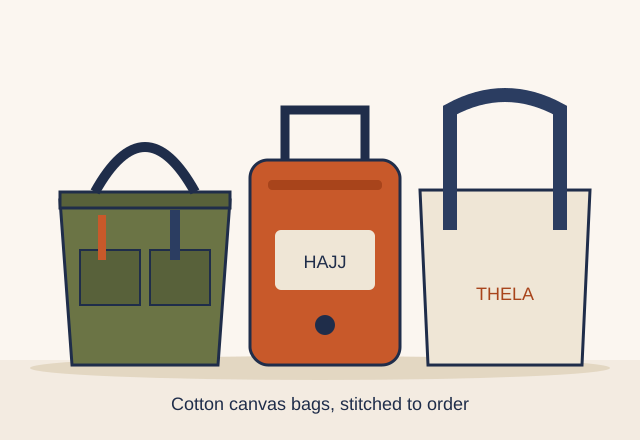
Once fabric is woven, coloured and finished, it moves to the stitching unit. This is where the canvas becomes a tent, a tarpaulin, a truck cover or a bag. The unit is equipped with advanced sewing machines suited to heavy canvas and staffed by operators with long experience of the material.
Sewing 450 or 600 gsm canvas is very different from sewing garments. Needles, thread, stitch length and seam type all have to be chosen for the load and weather the product will face. A tent roof seam, for example, is usually a folded, double-stitched seam that locks the raw edges inside so water and wind cannot work them loose. Corners and guy-rope points receive reinforcing patches. Tarp edges are hemmed before eyelets are punched, and eyelets are spaced so the load spreads along the sheet.
Typical stitching operations
- Marking and cutting panels to the pattern or drawing, avoiding any flagged weaving faults.
- Joining panels with folded, double-stitched seams for weather resistance.
- Adding reinforcement patches at stress points, ridge lines and pole positions.
- Fitting doors, windows, stove pipe openings, mud-flaps and inner tent attachments as specified.
- Inserting brass or aluminium eyelets, sewing on webbing, ropes and buckles.
Because the stitching team works next to the weaving and dyeing units, problems found at this stage, such as a shade variation between rolls, can be traced back and corrected the same day.
Packing unit: protecting goods and controlling landed cost
Packing is the last unit, and buyers sometimes underestimate it. Yet packing has a direct effect on both cost and quality. A tent folded carelessly can arrive creased, damp or with a missing bag of pegs. A tent packed too loosely wastes container space and raises freight per unit. Our well-managed packing unit is organised to avoid both problems.
Each order has a packing plan agreed with the buyer. Relief tents may be supplied rolled with poles and pegs, or in a carry bag with all components counted inside. Larger items such as the school tent can be bundled in polythene or packed in wooden boxes. Every pack is marked so it can be identified and distributed without opening.
| Format | Typically used for | Why buyers choose it |
|---|---|---|
| Roll pack | Family ridge tents | Compact, quick to hand out in relief distributions |
| Cotton carry bag | Military, marquee, camping tents | Reusable, keeps all parts together |
| Polythene bundle | Poles, accessories, tarps | Low cost, moisture protection |
| Wooden boxes | Large tents such as school tents | Protection during rough handling |
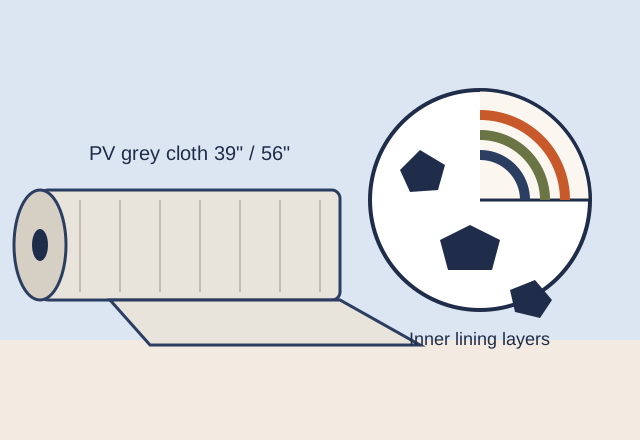
| Bales or rolls | Canvas fabric and polyester cloth | Efficient container loading |
From the packing unit, goods leave by the mode you choose. Our shipment page explains how we handle sea, road, air and courier dispatch.
How the units shape three typical products
Following a few products through the factory shows how the units cooperate in practice.
A 450 gsm family relief tent
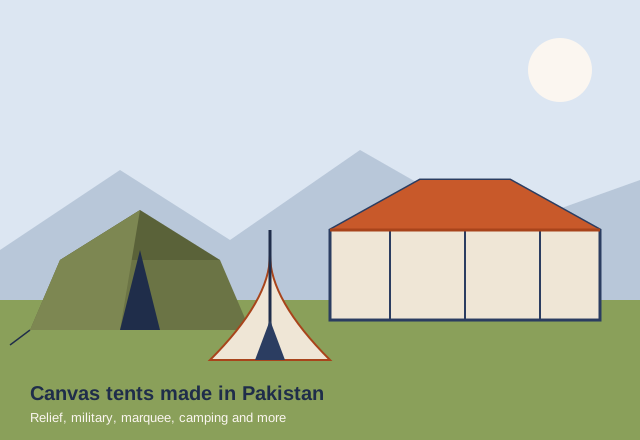
Doubling prepares a firm plied yarn; weaving produces tight canvas at the target weight; the dyeing unit gives it olive green or leaves it natural white and applies waterproof and rot-proof treatment; stitching assembles the double fly, inner tent and stove pipe opening; packing rolls or bags it with poles and pegs, ready for distribution.
A rip-stop tarpaulin
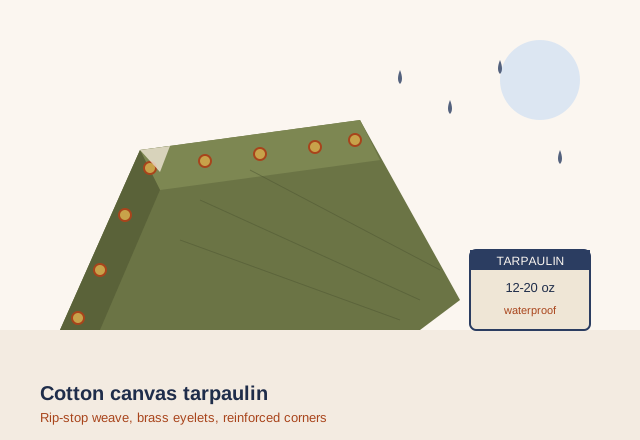
Weaving inserts stronger yarns at intervals to stop tears spreading. Finishing applies a chemical waterproofing or wax coat. Stitching hems the edges, adds corner patches and punches brass or aluminium eyelets. Packing folds the sheets flat in polythene for compact loading.
Ducting cloth by the roll
Here the stitching unit is bypassed. Yarn type and weight are chosen to the importer's specification, the looms produce long continuous lengths, and the packing unit winds and wraps rolls for container shipment to the Middle East.
Quality control across the canvas manufacturing units
Quality at Curiotex is not a single inspection at the end of the line. Each unit checks its own output before passing it on, which means faults are found where they are cheapest to fix.
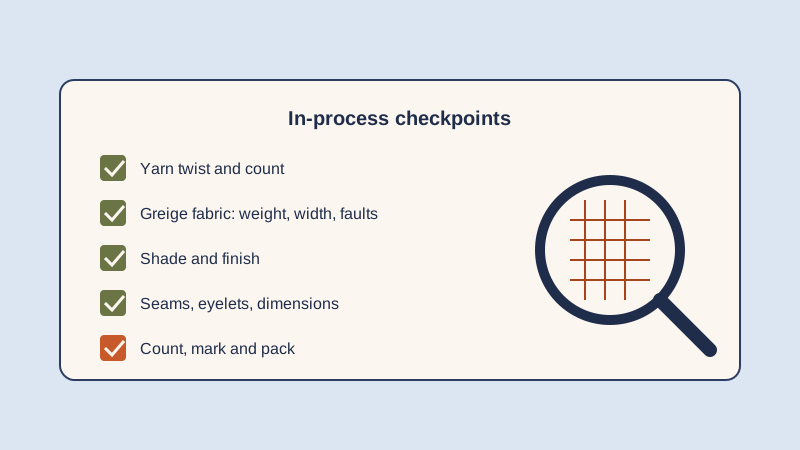
- Yarn check. Count and twist are confirmed after doubling.
- Greige check. Fabric weight, width and visible faults are recorded as cloth leaves the looms.
- Shade and finish check. Colour is compared to the approved standard and treatments are verified.
- Make-up check. Seams, reinforcements, eyelets and finished dimensions are measured against the drawing.
- Pack check. Components are counted and packs are labelled before loading.
Buyers and their appointed inspectors are welcome to attend at any of these stages. If defective goods do reach you, they can be returned for repair or replacement.
Why vertical integration matters to buyers
Owning every stage costs a manufacturer more in equipment and people than buying fabric on the open market. We do it because the benefits show up directly in what our customers receive.
Clear accountability
If a seam leaks or a shade drifts, there is one company to answer for it. No finger-pointing between weaver, dyer and sewer.
Specification control
We can change twist, density, colour or finish for a single order without negotiating with outside mills.
Faster samples
A sample can be woven, finished and sewn internally, so samples usually ship in about two weeks.
Predictable lead times
With no waiting for bought-in fabric, production normally runs 30 to 45 days from approval, depending on quantity.
For relief buyers this predictability is especially valuable. When an emergency appeal is launched, there is little time to chase several subcontractors. Having the whole chain in one company in Kasur, with a sales office in Lahore, keeps communication short.
See the units for yourself
We are happy to show buyers around. Many visitors start at our Lahore office in Gulberg III and then drive to the Kasur factory to see yarn on the doubling frames, canvas on the looms and tents taking shape on the stitching floor. If a visit is not practical, we can send photographs, swatches and samples instead.
To arrange a visit or request a sample, call Haji Ghulam Hasan on +92 317 8885522, email info@curiotex.com or use the send inquiry form. You can also read more about the company on About Us.
Frequently asked questions about canvas manufacturing units
What are the Curio Units?
The Curio Units are the five in-house canvas manufacturing units at our Kasur factory: doubling, weaving, dyeing, stitching and packing. Together they take locally bought yarn all the way to finished, packed tents, tarpaulins, covers, bags and fabric rolls without outsourcing any core step.
Why does yarn doubling matter for canvas?
Twisting two or more single yarns together produces a stronger, smoother and more even thread. Canvas woven from well-twisted plied yarn resists abrasion and tearing better and gives a tighter surface, which improves water resistance in tents and tarpaulins.
Do you weave all of your own canvas?
Yes, the canvas used in our products is woven in our own weaving unit under experienced supervisors. This lets us control weight, width and construction for each order. Fabric is weighed and measured before it moves on to dyeing and stitching.
How do you keep colours consistent across a large order?
Our dyeing unit uses in-house techniques and recipes for firm, fast colours on heavy cotton. Each batch is compared with the approved shade standard before cutting. Because recipes are ours, we can repeat a colour for follow-on orders.
Which finishes can the dyeing and finishing unit apply?
We can make canvas waterproof or water-impregnated, rot-proof, termite-proof, abrasion resistant and resistant to high temperatures. Tarpaulin canvas can also be wax coated. Finishes are applied to the whole fabric before stitching for even protection.
What kind of seams do you use on tents?
Tent roofs and walls are normally joined with folded, double-stitched seams that lock raw edges inside, with reinforcing patches at corners, ridges, pole points and rope attachments. Seam type and thread are chosen according to the fabric weight and the conditions the tent will face.
Can our inspector check goods during production?
Yes. Buyers and third-party inspection agencies are welcome at any stage, from yarn and greige fabric checks to final pack counts. We will make goods and records available and rework any items that do not match the agreed specification.
How does packing affect my cost?
Tight, well-planned packing reduces the volume each item takes in a container or aircraft, lowering freight per unit. It also protects goods from damp and damage and ensures every component is present, avoiding costly replacements at the destination.
Does vertical integration shorten lead times?
It removes the wait for fabric from outside mills and the coordination delays between subcontractors. Samples usually ship in about two weeks, and production typically takes 30 to 45 days from approval depending on quantity. See FAQ's for more ordering details.