
How to use this canvas buyer FAQ
Buying canvas products from abroad raises the same handful of practical questions every time: how do I pay, how long will it take, can I see a sample first, what happens if something is wrong? This canvas buyer FAQ answers each of them in depth, based on how Curiotex Industries Pakistan has worked with customers since 1975. The first half covers commercial terms; the second half helps you choose between products, fabric weights and finishes.
If you only need a quick answer, jump to the short question-and-answer list at the bottom of the page. If your question is not covered, contact us directly or send the details through our inquiry form.
Payment terms for new and returning buyers
For a first order we ask for either a Sight L/C or a 70% advance payment. These two options balance the risk for both sides when buyer and manufacturer have not yet traded together.
Sight letter of credit
A letter of credit is an undertaking by the buyer's bank to pay the seller once the seller presents documents that comply exactly with the credit's terms, typically the commercial invoice, packing list, bill of lading or airway bill and certificate of origin. "At sight" means payment is due as soon as the documents are checked and found compliant, rather than after a deferred period. The buyer is protected because the bank only pays against proof of shipment; the seller is protected because payment no longer depends on the buyer's goodwill once the goods have left.
70% advance
Under this option the buyer transfers 70% of the order value before production begins, and the balance is settled on the terms stated in the proforma invoice. Smaller orders often use this route because it avoids L/C bank charges and paperwork.
Whichever method you choose, only pay into the bank account printed on a Curiotex proforma invoice. If anyone tells you our banking details have changed, verify by calling +92 317 8885522 before sending money.
As a trading relationship builds, terms for repeat customers can be reviewed. Discuss this with our sales team once you have a few successful orders behind you.
Lead time from approval to dispatch
Our usual lead time is 30 to 45 days from product approval, and the exact figure depends on the quantity ordered. "Approval" means the specification is final, any sample has been accepted in writing, and payment or the L/C is in place. The clock does not start on the day of your first email.
Why a range rather than a single number? Canvas products pass through several stages in our in-house units: yarn doubling, weaving, dyeing or finishing, stitching and packing. A modest order of a standard tarpaulin flows through quickly; several containers of double-fly tents with inner linings and groundsheets need more loom time and more stitching hours. Seasonal peaks, such as the months before winter when shelter demand rises, can also affect scheduling.
Remember to add transport time. Our shipment guide explains the five modes we use and the factors that influence transit.
Samples, sample timing and sample cost
Yes, we provide samples, and we can also develop a new sample from a design you supply, whether that is a drawing, a photo or a physical product you want reproduced or improved. Seeing and handling a sample is the best way to judge fabric hand, weight, colour, stitching and fittings before committing to bulk.
How long a sample takes
Samples usually ship in about two weeks. Simple items made from fabric we already weave can be quicker; a new tent design with custom fittings may need the full period. International courier transit is then added, and courier is the normal mode for samples.
What a sample costs
For well-established customers, samples are offered at production prices, meaning you pay roughly what the item would cost in a bulk order rather than a premium for a one-off. For new buyers, sample charges and courier costs are confirmed case by case before we start, so there are no surprises.
Once approved, the sample becomes the quality reference for production. Keep your half of any counter-sample and note agreed changes in writing.
Minimum order quantity explained
We do have minimum order quantities, and they vary from product to product. The reasons are practical rather than arbitrary. Setting up a loom for a particular construction takes time and yarn, so very short fabric runs are uneconomic. Dyeing is done in batches, and a minimum batch is needed to keep the shade consistent. Stitched items such as tents, covers and bags require cutting patterns and line set-up for each design.
The easiest way to find out whether your quantity is workable is to tell us. Where an order falls below the minimum, we may suggest a standard colour instead of a special shade, combining sizes, or using a fabric already in production.
Returns, repairs and replacements
If goods arrive defective, they can be returned to us for repair or replacement. Our aim is to put the problem right, not to argue about it. To make a claim straightforward:
- Inspect goods promptly on arrival and before distribution or resale.
- Photograph the defect clearly, along with package labels and lot numbers.
- Email the photos and a short description to info@curiotex.com, quoting the order or invoice number.
- We review the evidence and agree with you whether repair or replacement is the right remedy and how goods should be returned.
Damage caused in transit is a different matter and is generally handled through the cargo insurance policy and the carrier, so note any visible damage on the delivery receipt before signing. Pre-shipment inspection, either by your own staff or a third-party inspector, is the best way to catch issues before goods leave Pakistan.
What determines your shipping cost
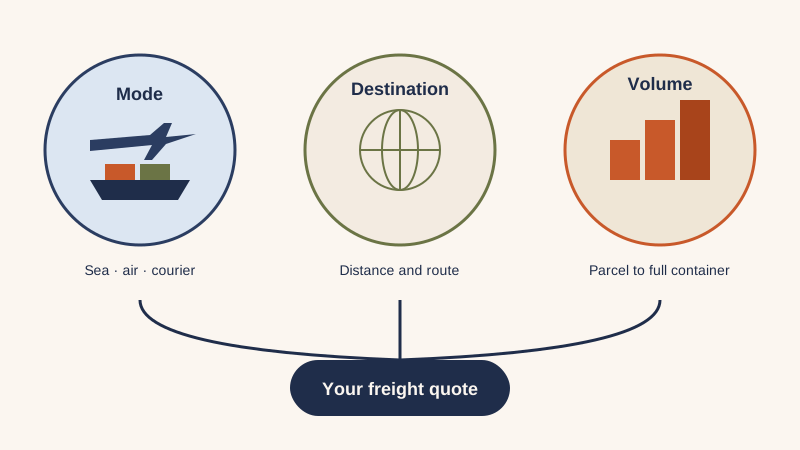
Shipping cost depends on three things: the transport mode, the destination, and the size of the consignment. Sea freight is far cheaper per kilogram than air, while international courier is the costliest and suits samples and small parcels. Distant or less-served destinations cost more than busy trade lanes, and a full container usually works out cheaper per unit than a part load.
We can ship by sea, by air or by international courier, and we also arrange container, truck and charter-flight movements. Because rates change frequently, we quote freight at the time of the offer rather than publishing a price list. If you prefer to use your own forwarder, ask for an EXW or FOB price instead.
Visiting Curiotex in Pakistan or at trade fairs
Buyers are welcome to visit. Our sales office is in Gulberg III, Lahore, and our factory and head office are in Kasur, south-east of Lahore. A visit lets you meet the team, review samples, discuss specifications in person and, at Kasur, see doubling, weaving, dyeing, stitching and packing first hand. Please book in advance so the right people and samples are ready.
We also display our products at some major industry fairs. Ask us which events are planned if you would prefer to meet closer to home. Full addresses and directions are on the contact page.
Where our raw material comes from
Our raw material is purchased locally in Pakistan. The country has a large cotton and spinning industry, and buying yarn domestically keeps supply lines short and lets us respond quickly to changes in specification. Because we twist and weave the yarn ourselves, we control the canvas construction from the yarn stage onward rather than relying on bought-in fabric for our tents, tarpaulins and bags.
Local sourcing also matters for documentation. Goods made from local material in our own factory are straightforward to describe on a Pakistani certificate of origin, which some importers need for customs purposes.
The order journey in five steps
Many questions in this canvas buyer FAQ make more sense once you see where they fit in the life of an order. Payment terms come into play after the quotation; samples sit between specification and approval; lead time runs from approval to dispatch; returns apply only after delivery. The diagram below lays out that sequence.
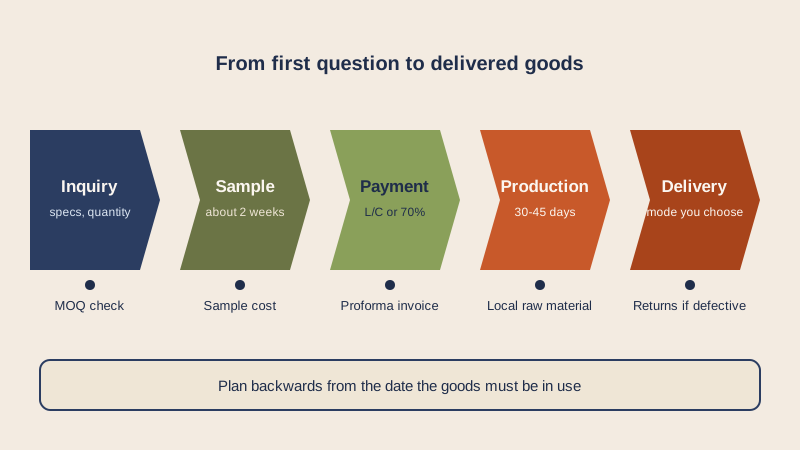
Treat it as a planning aid. If you know your goods must be in a warehouse in Accra, Jeddah or Dubai by a particular date, count back through each step, allow for sample approval and bank processing on your side, and you will know roughly when the inquiry needs to be sent.
Choosing the right canvas weight: gsm and ounces
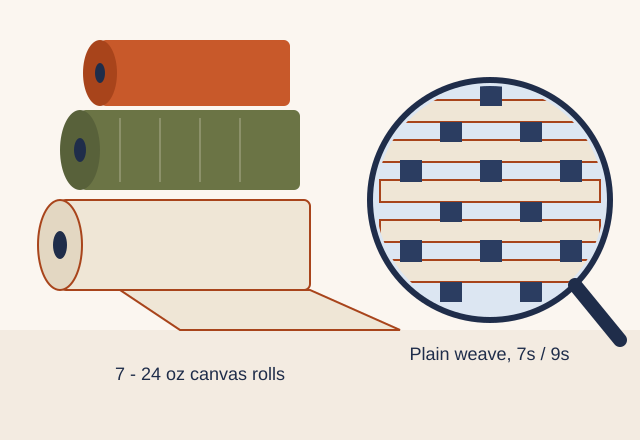
Fabric weight is one of the most useful single indicators of canvas strength and durability. Tent canvas is usually described in grams per square metre (gsm), while tarpaulins and truck covers are often specified in ounces per square yard. As a rough conversion, one ounce per square yard is about 34 gsm.
| Product | Typical weight | What it suits |
|---|---|---|
| Camping, bell and scout tents | 270-450 gsm | Recreation, youth groups, lighter handling |
| Family relief and ridge tents | 400/450 gsm | Emergency and transitional shelter |
| Military, hospital and marquee tents | 450-600 gsm | Long-term and institutional use |
| Store and frame tents | 500-600 gsm | Warehousing, field hospitals, harsh weather |
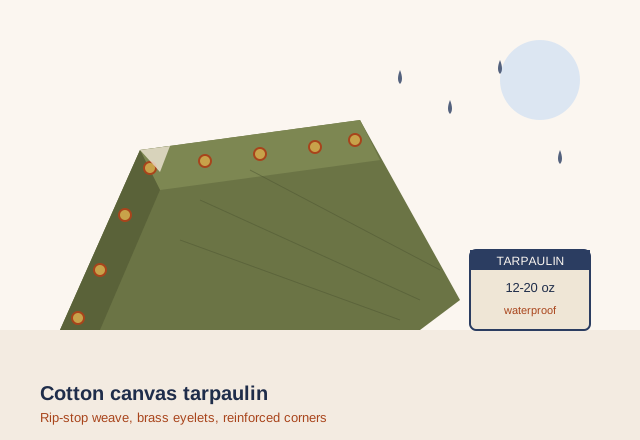
| Canvas tarpaulins | 12-20 oz | Construction, storage, goods covering |
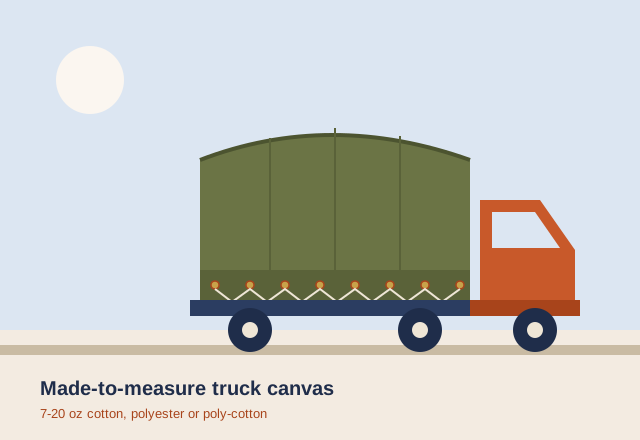
| Truck canvas | 7-20 oz | Lorries, jeeps, machinery covers |
Heavier is not always better. Weight adds cost, freight and handling effort, so match it to how long the product must last and how harsh the conditions are. For a single-season relief deployment, a 400 gsm tent may be adequate; for a military camp expected to stand for years, 500 or 600 gsm makes more sense.
Which tent type fits your project?
Our canvas tents range covers many uses, and buyers sometimes struggle to pick between similar designs. A few rules of thumb help.
Family shelter
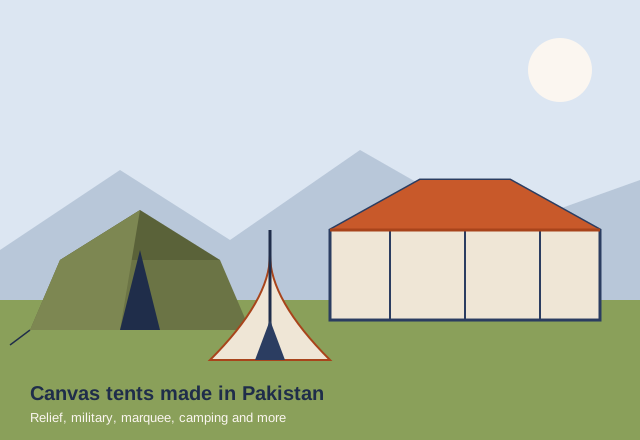
Ridge tents and single-pole tents built to the widely used UNHCR family-tent pattern suit displaced households. Choose double fly and inner lining for cold climates, or a winterized model. See refugee tents.
Medical and storage
Frame tents and long marquee-style tents give unobstructed floor space for beds or stacked goods. The hospital tent at 10.97 × 5.94 m is a common choice.
Military and command
Command post, officer and frame tents in olive green with rot-proof finishes. See military tents.
Events and hospitality
Party marquees and deluxe tents with decorative inner folds suit weddings and dinners. See marquee tents.
Waterproof, rot-proof and other canvas finishes
Raw cotton canvas swells when wet, which closes the weave and sheds rain, but it can also absorb water and eventually rot if left damp. Finishes improve its performance. Chemical waterproofing treats the fibres to repel water; wax coating fills the surface for a heavier, more water-resistant tarpaulin; rot-proofing protects against mildew and fungal attack in humid climates. We can also produce termite-proof, abrasion-resistant and high-temperature-resistant fabric for specific environments.
Tell us where the product will be used. A tarpaulin covering goods at a desert construction site faces sun and abrasion, while a tent in a monsoon region needs strong water and rot resistance. Matching the finish to the climate gives the best service life for the money.
Quick canvas buyer FAQ
How do first-time buyers pay Curiotex?
New customers choose between a letter of credit payable at sight and an advance of 70% of the order value, with the balance as set out on the proforma invoice. Terms for regular customers can be discussed after a few completed orders.
How long after approval will my goods be ready?
Typically 30 to 45 days, counted from the date the specification or sample is approved and payment arrangements are in place. Larger orders sit at the upper end of that range. Transit time is added separately.
Can I get a sample before placing a bulk order?
Yes. We supply samples of existing products and can create new ones from your drawings or reference items. Expect dispatch in roughly two weeks, plus courier transit to your address.
What will a sample cost me?
Long-standing customers receive samples at production prices. For new buyers, we confirm the sample charge and courier cost before starting work, so you can approve it in advance.
Is there a minimum quantity I must order?
There is, and it depends on the product. Woven fabrics, special dye shades and stitched designs each need a practical minimum run. Share your intended quantity and we will tell you whether it works.
What if part of my order is defective?
Report it promptly with photos, lot numbers and your invoice number. Defective goods can be returned to us for repair or replacement, and we agree the method with you once we have reviewed the evidence.
Why can't you publish a fixed shipping price?
Freight depends on the mode, the destination and the size of the consignment, and market rates move often. We include a current figure in your quotation, or quote EXW or FOB if you prefer your own forwarder.
Can I visit before ordering?
Yes. Our Lahore office and Kasur factory welcome buyers by appointment, and we also exhibit at some major industry fairs. See the contact page for addresses and booking details.
Where do you buy your yarn and raw material?
Locally, within Pakistan. We then twist, weave, dye and stitch in our own units, which gives us control over fabric quality from the yarn stage.
Which fabric weight should I choose for a relief tent?
Most family relief tents use 400 or 450 gsm cotton canvas, which balances durability, weight and cost. For colder regions or longer deployments, consider double fly with inner lining or a winterized design.