Polyester fabric Pakistan manufacturers have woven as grey cloth since 1975
Alongside heavy cotton canvas, Curiotex Industries Pakistan weaves a family of lighter grey fabrics built on polyester. We have produced grey cloth in a range of qualities since 1975, and today our polyester fabric from Pakistan goes mainly to manufacturers who laminate it into the inner lining of footballs, with further demand from garment, packaging and technical buyers. "Grey" here is a trade word, not a colour: it means cloth as it comes off the loom, before bleaching, dyeing or printing.
Supplying grey cloth well depends on doing a few things consistently. Counts must be spun and twisted to specification, thread density must stay the same from the first metre to the last, and widths must be accurate because cutting tables and laminating lines are set to them. We look after these points with our own doubling and weaving units and a team that has run these constructions for many years. Our commitment is simple: quality the buyer can rely on, honest dealing and up-to-date techniques.
The sections below list the fibre blends we weave, explain how to read our construction codes, describe the sizing finish used for lining cloth, and set out how to order. If you have a construction of your own, send it through the inquiry form and we will confirm whether it fits our looms.
Fibre blends: PV, PC, PP and cotton
Each blend behaves differently in lamination, sewing and use. We weave five fibre families, and the choice usually follows the buyer's laminating process and price target.
Polyester viscose (PV)
Polyester gives strength and dimensional stability; viscose adds absorbency and a softer hand. PV grey cloth bonds well to adhesives and is the most common lining base we make.
Polyester cotton (PC)
A blend with cotton content for buyers who want a natural-fibre feel with better strength than pure cotton. We pair PC warp with cotton weft in one sized quality.
Pure polyester (PP)
100% polyester yarn in warp and weft. Low stretch, strong, resistant to moisture and rot, and stable through heat processes.
Cotton
All-cotton grey cloth for uses where breathability, dye uptake or natural content matter.
Canvas
For heavier needs, our cotton canvas range is described on the canvas fabric page.
In the yarn codes used on this page, "pv" stands for polyester-viscose yarn, "pc" for polyester-cotton, "pp" for pure polyester and "ctn" for cotton. These abbreviations follow local trade usage; please note that in our listings "pp" means pure polyester, not polypropylene.
Polyester fabric as football inner lining
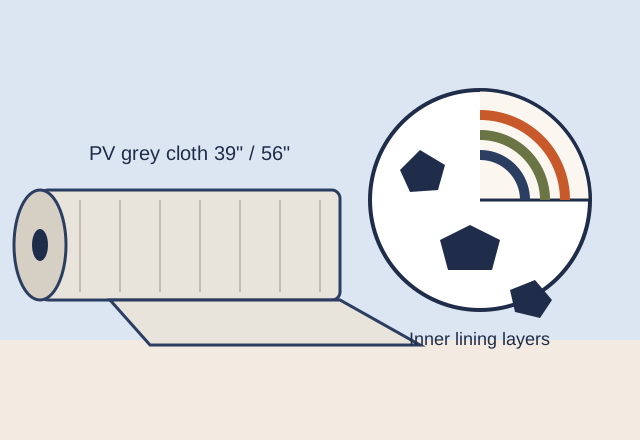
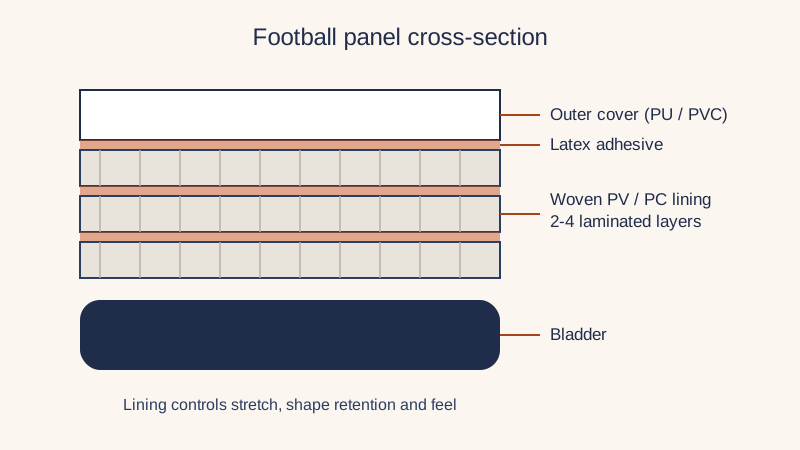
A stitched or bonded football is more than its printed outer panels. Beneath the cover sit one or more layers of woven fabric, laminated together and to the cover with latex or another adhesive. These lining layers control how much the ball stretches, help it keep a round shape, influence how it feels when kicked and stop the bladder from bulging between seams. A ball with poor lining loses shape quickly; one with stable, well-bonded lining holds its geometry through many matches.
Woven grey cloth is ideal for this job because its warp and weft lines resist stretch in two directions, and blending polyester with viscose or cotton gives a surface that takes adhesive well. Manufacturers typically choose the number of layers and the fabric construction according to the grade of ball, from training balls to match balls. Pakistan's long history in ball making means there is steady local demand for lining cloth, and we supply it in widths that suit the laminating machines used in the industry.
Reading polyester fabric constructions
Our qualities are described with a compact code. Using the first line of the table, 36/2pv×36/2pv / 50×50 39",56", the parts read as follows.
- 36/2pv × 36/2pv is warp count × weft count. Each is a 36s polyester-viscose yarn doubled two-ply ("/2"). A plain "36pv" with no "/2" means single yarn.
- 50 × 50 is ends per inch × picks per inch: 50 warp threads and 50 weft threads in every inch of grey cloth.
- 39", 56" lists the widths in which the quality is woven, in inches (about 99 cm and 142 cm).
The count system is the English cotton count used across Pakistan's spinning industry; a higher number means a finer yarn. So 40pv is finer than 26pv, and a fabric woven 40×40 at 48×48 is lighter and smoother than one woven 26×26 at 38×38, even though the second has fewer threads per inch. Where a mixed code appears, such as 36pv/2×36pv, the warp is two-ply and the weft is single, which is a common way to strengthen the lengthwise direction where loom tension is highest.
Two fabrics with the same counts can still differ: thread density, twist, blend ratio and finishing all change weight and handle. That is why we ask for a swatch when you want to match a cloth you already use.
Standard polyester grey cloth constructions
These are the constructions we weave regularly. Other combinations can be produced on request when they fall within our loom settings.
| Warp × weft count | Ends × picks per inch | Width | Notes |
|---|---|---|---|
| 36/2pv × 36/2pv | 50 × 50 | 39", 56" | Two-ply PV both ways; strong, balanced |
| 36pv × 36pv | 30 × 30 | 39" | Single PV, open and light |
| 36pv/2 × 36pv | 60 × 30 | 39" | Plied warp, warp-dense construction |
| 26pv × 26pv | 38 × 38 | 39" | Supplied with sizing |
| 17pc × 20ctn | 28 × 28 | 39" | PC warp, cotton weft; supplied with sizing |
| 20pp × 20pp | 34 × 34 | 39" | Pure polyester, heavier yarn |
| 40pv × 40pv | 48 × 48 | 39", 56" | Fine PV, smooth surface |
For lining buyers, the balanced two-ply 36/2pv quality and the fine 40pv quality are often used where the ball must stay round under hard use, while the open 36pv 30×30 and the sized qualities suit applications where adhesive penetration and cost matter more. We are happy to discuss which construction suits your ball grade or end product.
Choosing between PV, PC and pure polyester fabric
Buyers new to lining cloth often ask which blend is "best". The honest answer is that each one trades strength, absorbency, bonding behaviour and cost differently, and the right choice depends on what happens to the cloth after it leaves our mill. The comparison below summarises the general behaviour of each fibre family in grey form.
| Property | PV | PC | Pure polyester | Cotton |
|---|---|---|---|---|
| Tensile strength | Good | Good | Very good | Moderate |
| Moisture absorption | Medium to high | Medium | Low | High |
| Adhesive bonding | Very good | Good | Fair, needs suitable adhesive | Good |
| Resistance to rot and mildew | Fair | Fair | Excellent | Poor untreated |
| Dimensional stability | Good | Good | Very good | Fair, shrinks when wet |
For football lining, PV is popular because the viscose component lets latex wet the surface quickly, giving a firm bond between layers. Pure polyester is chosen when the finished product must cope with damp storage or wet use and the converter has an adhesive system that grips synthetic fibre well. PC with a cotton weft sits between the two and is attractive where a buyer wants some natural content at a sensible price. Cotton alone is mostly ordered for dyeing and printing bases rather than lamination.
Weight follows construction as much as blend. A denser sett or a plied yarn raises grams per square metre, and so does sizing. When you compare quotations from different mills, compare the full construction string and the stated finish, not just the blend name, otherwise a cheaper offer may simply be a lighter, more open cloth that behaves differently on your laminating line.
What the sizing finish does
Two of our constructions, 26pv×26pv / 38×38 and 17pc×20ctn / 28×28, are offered with sizing. Sizing is a film of starch or synthetic polymer applied to the yarn or cloth. In weaving it protects warp yarns from abrasion on the loom; when it is left on the finished grey cloth, it also gives the fabric a crisp, stiff handle.
Why sized cloth helps converters
- Easier handling: stiff cloth feeds flat through laminating and cutting machines and is less likely to skew or wrinkle.
- Stable geometry: sizing locks the open, lower-density constructions so threads do not slip before lamination.
- Controlled adhesive uptake: the sized surface limits how deeply latex or glue soaks in, which helps keep weight and stiffness predictable.
- Clean cutting: edges fray less when panels are die-cut.
If your process includes desizing, dyeing or printing, tell us in advance; the sizing type and quantity can be adjusted, or unsized cloth can be supplied.
Other uses for PV and PC grey cloth
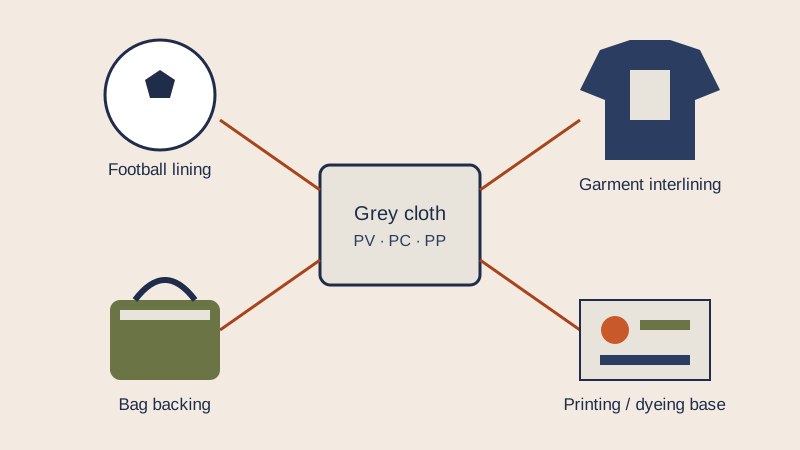
Although sports goods lining is the largest outlet for this range, the same grey fabrics are useful elsewhere. Garment makers use PV and PC cloth as pocketing, interlining and lining; bag and luggage makers laminate it behind coated outers; shoe and leather-goods workshops use it as backing; and printers and dyers buy grey cloth as a base for their own finishing. Pure polyester cloth suits applications that meet moisture, since it does not rot. Buyers who need heavier natural-fibre fabric for covers or tents can look at our tarpaulin and canvas tents lines, which draw on the same weaving know-how.
Quality control in our weaving units
Our grey cloth passes through the same in-house chain as our canvas: yarn doubling on our own frames, weaving under experienced supervisors, and a packing unit that prepares each lot for shipment. Grey goods are inspected for broken ends, missing picks, thick and thin places, oil stains and width variation. Rolls are measured and labelled with quality code, construction, width and length so you can trace any piece back to its loom lot. You can read about each department on the Curio Units page.
Raw material is purchased locally in Pakistan, which keeps supply steady and lets us respond to repeat orders without long yarn import delays. If a delivered roll proves defective, it can be returned for repair or replacement under our standard terms.
Ordering polyester fabric from Pakistan
To quote accurately we need the construction (or a swatch), the width, any sizing or finishing requirement, quantity, packing preference and destination. Samples can be developed to your specification and typically ship in about two weeks; established customers may receive them at production price. Bulk production normally takes 30 to 45 days from sample approval, depending on quantity.
Minimum quantities vary by quality. New customers usually work on sight L/C or a 70% advance. Grey cloth is packed in rolls or bales and can travel by container, truck, air or courier, as described on our shipment page.
Contact Haji Ghulam Hasan on +92 317 8885522 or at info@curiotex.com, visit our Lahore office at PL-20 Siddiq Trade Center, Gulberg III, or send your specification using the Send Inquiry page.
Polyester fabric Pakistan: frequently asked questions
What polyester fabrics does Curiotex weave?
We weave grey cloth in polyester viscose (PV), polyester cotton (PC), pure polyester (PP) and cotton, alongside our cotton canvas. Standard constructions range from 36pv×36pv at 30×30 to 40pv×40pv at 48×48, in 39 inch and, for some qualities, 56 inch widths.
What is grey cloth?
Grey cloth, also called greige, is fabric as it comes off the loom, before bleaching, dyeing, printing or other finishing. It is usually off-white. Buyers use it as is, for example laminated as football lining, or send it to their own processors for finishing.
Why is polyester-viscose used for football inner lining?
Woven PV cloth resists stretch in both directions, bonds well to latex adhesives and is light. Laminated beneath the outer cover, it helps the ball keep its round shape and consistent bounce. Our 36/2pv and 40pv qualities are commonly chosen for this purpose.
How do I read a code like 36/2pv×36/2pv / 50×50 39"?
The first part gives the warp and weft yarns: 36s polyester-viscose, two-ply in both directions. The second part gives 50 ends and 50 picks per inch. The last figure is the cloth width, 39 inches. A code without /2 refers to single yarn.
Does PP mean polypropylene in your fabric list?
No. In our construction list, pp stands for pure polyester, so 20pp×20pp / 34×34 39 inch is a 100% polyester grey cloth woven from 20s yarn in both warp and weft. We do not currently list polypropylene woven fabric on this page.
What is the purpose of sizing on grey cloth?
Sizing is a starch or polymer coating that protects warp yarn during weaving and, when left on, makes the cloth stiffer. Our 26pv×26pv and 17pc×20ctn qualities are supplied sized, which helps them feed flat through laminating and cutting machines and keeps open constructions stable.
Can you weave a construction that is not in your standard list?
Often yes, as long as it suits our looms and yarn availability. Send the counts, thread density, width and intended use, or simply a swatch, and we will confirm feasibility and weave a sample for approval before bulk production.
What widths are available?
Most qualities are woven 39 inches wide, and the 36/2pv 50×50 and 40pv 48×48 qualities are also available at 56 inches. Ask through our inquiry form if your laminating line needs a different width.
What are the lead time and payment terms for polyester grey cloth?
Samples usually ship in about two weeks; bulk orders normally take 30 to 45 days after sample approval, depending on quantity. New customers generally pay by sight L/C or 70% advance. Minimum quantities differ from one quality to another.