Canvas tents from Pakistan for relief, defence, events and outdoor life
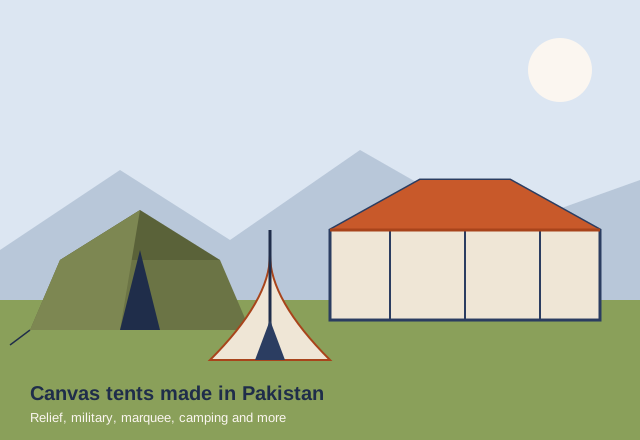
Tents are the product line Curiotex is best known for, and emergency relief tents remain our priority export. Our canvas tents in Pakistan are built from cloth that we twist, weave, dye and proof ourselves, then cut and sew in our own stitching unit in Kasur. Controlling the fabric from the yarn stage means we can match weight, colour and finish to the job, whether that is a family shelter for a flood-affected district, a command post in mountain terrain or a wedding marquee in a city lawn.
Our tents are sold within Pakistan and exported, mainly to disaster-affected regions, the Middle East and West Africa. All of them use abrasion-resistant cotton canvas intended for harsh weather, and the factory can add special finishes: waterproof and water-impregnated proofing, rot-proofing, termite-proofing, abrasion resistance and high-temperature resistance. This page is the starting point for the whole range. Each family below has its own detailed page with sizes and specifications.
The nine Curiotex tent families
Refugee and relief tents
Family ridge tents in single or double fly, tents built to the widely used UNHCR family-tent pattern, winterized tents, African refugee tents and dispensary frame tents, mostly in 400/450 gsm canvas.
Military tents
Command post, senior officer, standard marquee, Marquee Universal G.S. and two military frame tents, designed for long use in tough field conditions.
Marquee tents
Multiple-pole marquees for 100 to 300 guests, single-pole party tents and marquee party tents in natural white, solid colours or stripes.
Store tents
A 600 gsm heavy-duty store frame tent, 14 x 6 m, with fitted PVC groundsheet for keeping supplies dry through winter.
Camping tents
Scout tents, a 10-person bell tent, Nepal mountain tents and the budget Sunset Cabin tent in 270 to 450 gsm canvas.
Deluxe tents
The SDT/11 hospitality tent for caterers and event organisers, with plain or printed inner fold and coloured lining.
School tents
The STR/25 temporary classroom in 6 x 12 m and 5 x 8 m, with double fly and cotton lining for rehabilitation programmes.
Hospital tents
A 10.97 x 5.94 m single or double fly hospital tent in 500 gsm canvas, popular with armies and disaster response teams.
General and shelter tents
Double pole regulation and shelter tents, a 12 x 6 m general purpose tent and hospital/store frame tents for mixed duties.
Canvas tent comparison: type, canvas weight and typical use
The table summarises the main models across the range so buyers can narrow the field quickly. Weights are for the main canvas; inner tents, linings and groundsheets are specified separately.
| Tent | Typical canvas | Key size | Main use |
|---|---|---|---|
| Family ridge tent (single / double fly) | 400/450 gsm | 4x2 to 6x4 m | Family shelter, relief camps |
| UNHCR-pattern double fly single pole | 400/450 gsm | Inner 4x4 m | Family shelter, cold climates with lining |
| Winterized tent | 400/450 gsm | Inner 4.05x4.05 m | Winter relief with PVC groundsheet |
| African refugee tent | Roof 500-525, walls 450 gsm | 5x5 m | Relief in hot, wet climates |
| Command post tent | 450 gsm | 2.8x2.8 m | Field command, small units |
| Standard marquee (military) | 500/600 gsm | 6x6 to 12x6 m | Accommodation, storage, relief |
| Multiple pole marquee | 500-600 gsm | 15x7 to 30x10 m | Events for 100-300 people |
| Store frame tent | 600 gsm | 14x6 m | Winter storage of supplies |
| Bell tent | 280/325/450 gsm | 4 m diameter | Camping, sleeps 10 |
| Deluxe tent SDT/11 | Grey or waterproof canvas | 4x4 m to 18x30 m | Weddings, dinners, catering |
| School tent STR/25 | 450 g/m² fly, 170 g/m² lining | 6x12 m, 5x8 m | Temporary classrooms |
| Hospital tent | 500 gsm | 10.97x5.94 m | Field and disaster hospitals |
| General purpose tent | 500 gsm | 12x6 m | Hospital, storage, dispensary |
Tent canvas, weights and special finishes
Weight in grams per square metre is the first number most tent buyers check, and it is a sound guide. Lighter 270 to 325 gsm canvas suits camping tents that are carried and pitched often. The 400 to 450 gsm band is the workhorse for family shelters and officer tents that must last months. At 500 to 600 gsm, canvas becomes stiff and very durable, which is why we use it for marquees, hospital tents and store tents that stand for long periods or carry large roof spans.
Weight is not everything, however. Our yarn is doubled in-house to give a well-twisted thread, and weave density decides how tightly the cloth closes when wet. A dense, well-made 450 gsm canvas will often outperform a loosely woven heavier one. Colour is handled in our dyeing unit, using methods that give firm, fade-resistant shades; natural white and olive green are standard, with other colours to order.
Finishes we can apply
- Waterproof and water-impregnated proofing for steady rain.
- Rot-proof treatment for tents pitched on damp ground or stored in humid depots.
- Termite-proof treatment for tropical and sub-tropical deployments.
- Abrasion resistance for tents that are pitched and struck repeatedly.
- High-temperature-resistant fabric for desert heat and tents with stoves.
Single fly versus double fly canvas tents
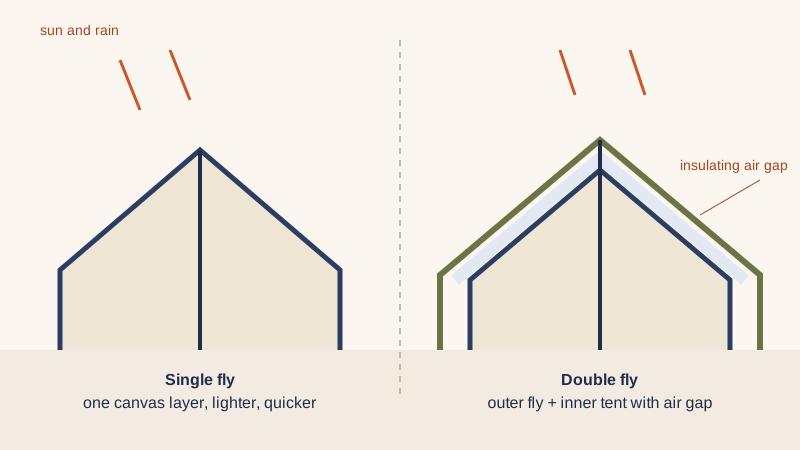
A single fly tent has one layer of canvas forming roof and walls. It is lighter, cheaper, faster to pitch and perfectly adequate in mild climates or for short-term use. A double fly tent adds an outer roof or full outer tent pitched over the inner one, separated by an air gap. That gap is what makes the difference: it shades the inner tent from direct sun, reduces condensation, sheds heavy rain before it reaches the inner layer, and in cold weather traps a layer of insulating air.
For relief work in regions with hot summers and cold winters, double fly designs are usually the better long-term investment, often combined with an inner lining and a stove pipe opening. Many of our family, officer and hospital tents can be supplied either way, so the decision can be matched to climate and budget rather than forced by the model.
Frame tents versus pole tents
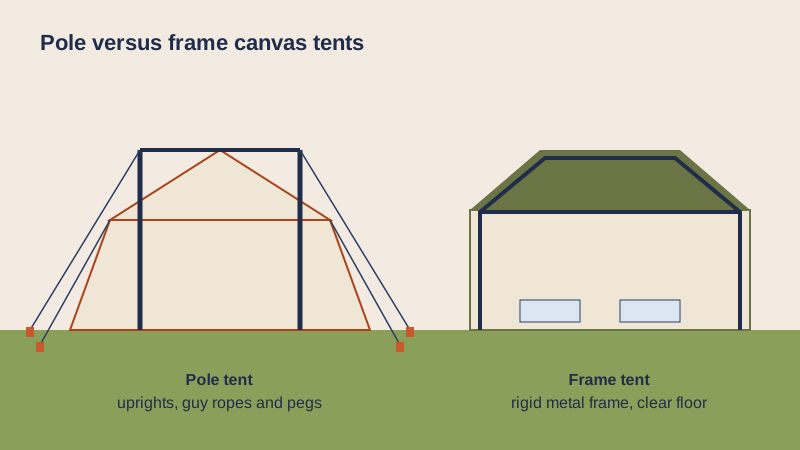
Classic pole tents, such as ridge tents, single pole tents and marquees, are held up by vertical poles and tensioned by guy ropes and pegs. They are economical, pack compactly and are quick to pitch once teams are trained. The trade-off is that centre poles occupy floor space and the tent depends on firm ground for its pegs.
Frame tents carry the canvas on a rigid metal framework. The floor is unobstructed, which matters for hospital beds, store racks, workshop benches and classrooms, and walls stand straighter, so usable volume is higher. Our military frame tents, dispensary and hospital/store frame tents all follow this approach. Frame tents need more packing volume and slightly longer to erect, but are generally preferred for long-standing installations.
Groundsheets, linings and accessories for canvas tents
The canvas shell is the core of any tent, but accessories decide how comfortable and durable it is in the field. Groundsheets come in three materials. Canvas groundsheets breathe and are repairable; PE (polyethylene) sheets are light and inexpensive; PVC sheets are the heaviest and most resistant to damp and wear, which is why we fit them as standard on store and winterized tents. A sewn-in or fitted groundsheet also seals the base against insects, dust and draughts.
For cold regions, an inner tent with cotton lining creates a warmer living space, and a stove pipe opening lined with heat-resistant material lets families or troops use a heater safely. Mud flaps along the base, such as the heavy-duty PE flap on our bell tent, keep wind and water from blowing under the walls. Every tent leaves the factory with its own poles, iron pegs and carry bag, and marquees also include pins and a hammer so crews have everything needed on arrival.
Who buys canvas tents from Pakistan
Our tent customers fall into a few broad groups. Humanitarian organisations and NGOs order family and winterized shelters, school tents and dispensary tents for displacement and rehabilitation work. Government and defence procurement offices buy command post, officer, frame and hospital tents. Importers and traders in the Middle East and Africa stock marquees, store tents and general purpose tents for resale. Event companies, caterers and wedding organisers order marquee and deluxe tents, while schools, scout groups and outdoor clubs look for bell, scout and Nepal tents. Each group values different things, from fast dispatch to decorative linings, and we adjust specifications accordingly.
Choosing the right canvas tent for your project
- Define the occupants or contents. Families, soldiers, patients, pupils, guests or stored goods each point to a different family.
- Check climate and season. Cold winters suggest double fly with lining and stove opening, or a winterized tent; hot, wet regions favour heavier roofs and rot-proofing.
- Decide duration. Weeks, months or years affects canvas weight and whether a frame is worth it.
- Consider logistics. Weight and packed volume per unit drive freight cost; lighter designs suit air drops and courier.
- List accessories. Groundsheets in canvas, PE or PVC, inner tents, linings, stove pipe openings, carry bags.
- Talk to us. Our team regularly guides buyers between options; send your brief through the inquiry form.
Relief buyers often ask for tents to a published specification. We build family tents to the widely used UNHCR family-tent pattern and to buyer specifications, and we can develop samples to your drawings for approval before bulk production.
Pitching and caring for canvas tents
Choose level, well-drained ground and clear stones and sharp objects before laying out the tent. Assemble poles or frame, raise the structure, then peg corners first and work along the sides, tensioning evenly so the roof does not pond. New cotton canvas benefits from a first wetting: fibres swell and the weave tightens, so a little seepage on a brand-new tent usually stops after the first rain. Slacken guy ropes in prolonged rain, as wet canvas and cotton ropes shrink.
Never pack a tent away wet. Dry it thoroughly, brush off mud, and store it in a ventilated, dry place off the floor. Avoid detergents, which strip proofing, and keep fuel, solvents and open flame well away from the fabric. Small tears can be stitched and patched with matching canvas, which is one of the long-term strengths of cotton tents compared with laminated synthetics.
Export packing and shipping of tents from Pakistan
Our packing unit bundles each tent so it can be counted, checked and distributed easily: canvas rolled or folded into its carry bag, poles and pegs bundled, accessories boxed. Some models, such as the school tent, can be packed with poles and accessories in polythene bundles or wooden boxes. Packing is planned to make good use of container space, which has a direct effect on landed cost.
Shipment can be by sea container, truck, charter flight or courier, as described on the shipment page. Typical lead time is 30 to 45 days from sample approval, depending on quantity, and samples generally ship in about two weeks. For new customers, payment is by sight L/C or 70% advance. Call +92 317 8885522 or email info@curiotex.com to discuss your requirement.
Canvas tents Pakistan: frequently asked questions
Which types of canvas tents does Curiotex manufacture?
We make nine tent families: refugee and relief tents, military tents, marquee tents, store tents, camping tents, deluxe hospitality tents, school tents, hospital tents and general purpose or shelter tents. Each family has several models and sizes, and custom designs can be developed on request.
What canvas weight is used in your tents?
Camping tents use 270 to 450 gsm cotton canvas, family and officer tents mostly 400/450 gsm, and marquees, hospital, general purpose and store tents 500 to 600 gsm. The African refugee tent combines a 500-525 gsm roof with 450 gsm walls.
Are your tents UNHCR approved?
We do not claim UN approval. Our family tents are built to the widely used UNHCR family-tent pattern and to the specifications buyers send us, and we can produce samples for your technical team to inspect before an order is placed.
Should I choose a single fly or double fly tent?
Single fly is lighter and cheaper and fine for mild climates or short use. Double fly adds an outer layer with an air gap that reduces heat, condensation and rain penetration and improves warmth in winter. For long relief deployments in variable climates, double fly is usually worth it.
What special finishes can be added to tent canvas?
We can supply waterproof and water-impregnated canvas, plus rot-proof, termite-proof, abrasion-resistant and high-temperature-resistant finishes. Specify them at the inquiry stage because they affect processing.
Do tents come with poles, pegs and groundsheets?
Tents are supplied with metal poles, iron pegs and a carry bag as standard. Groundsheets in canvas, PE or PVC are optional on most models and fitted as standard on some, such as the store frame and winterized tents. Inner tents, linings and stove pipe openings are available on many models.
Can you make tents in custom sizes or colours?
Yes. Natural white and olive green are standard, and other colours, printed inner folds or stripes are available on certain models. Sizes and specifications can be changed on request, and we can develop samples from your drawings.
What is the lead time for a tent order?
Production usually takes 30 to 45 days after product approval, depending on quantity. Samples generally ship in about two weeks. Transit time then depends on whether you ship by sea, truck, charter flight or courier.
What payment terms apply to new tent buyers?
For new customers we work on a sight letter of credit or a 70% advance. Minimum order quantities vary by model; share your requirement via the inquiry form and we will confirm.
Which tent is best for a field hospital?
Our hospital tent at 10.97 x 5.94 m in 500 gsm canvas is the usual choice. For an unobstructed floor, frame designs such as the military frame tent II or the 14 x 6 m hospital/store frame tent are also used for wards and clinics.