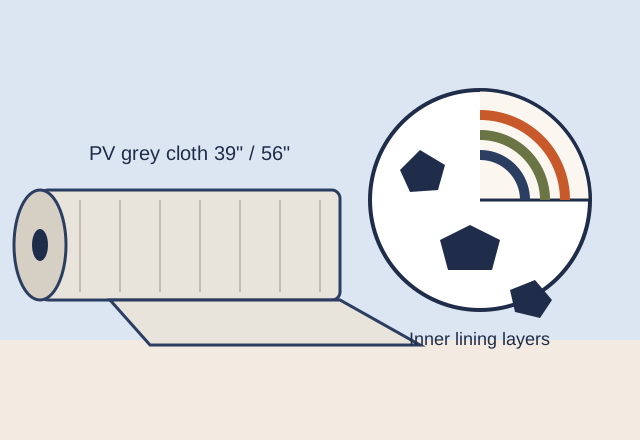
Canvas fabric Pakistan buyers can specify with confidence
Canvas fabric from Pakistan has a long reputation in the export trade because the country grows its own cotton, spins coarse yarns economically and has generations of weavers who understand heavy constructions. Curiotex Industries Pakistan belongs to that tradition. The family business has been weaving since 1975 in Kasur, close to Lahore, and today it supplies plain canvas, drop cloth, ducting cloth, sheeting and half panama to buyers who convert the cloth into tents, tarpaulins, bags, aprons, covers and household goods.
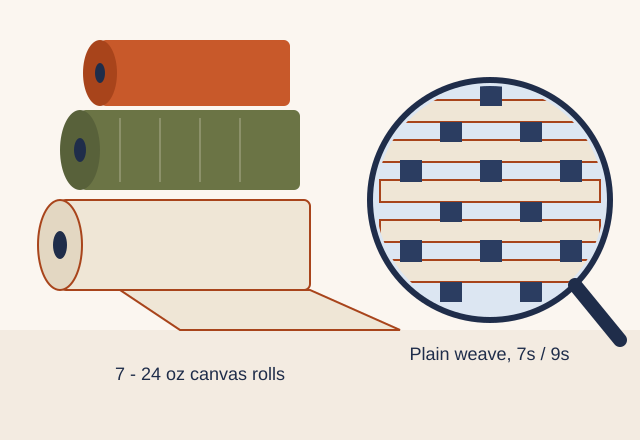
Most of what we weave is built from well-blended cotton yarn in 7s and 9s counts. Those are coarse, strong yarns, and they are the reason a canvas cloth feels firm in the hand, resists tearing at stitch lines and survives years of folding, sun and rain once it has been finished. Lighter qualities such as sheeting and half panama use finer counts, and we explain each one below so you can match a construction to the job instead of guessing from a photograph.
This page is written for purchasing managers, converters and traders who need numbers rather than slogans: what a yarn count tells you, how to read a construction string such as 20×10/40×36 59", how ounces relate to grams per square metre, what finishes are possible and how the cloth is packed for transport. If you already know the specification you want, you can go straight to our inquiry form.
Yarn counts 7s and 9s in cotton canvas cloth
Cotton yarn in South Asia is normally described with the English cotton count, written Ne or simply with an "s" after the number. The count tells you how many hanks of 840 yards it takes to weigh one pound. A higher number means a thinner yarn: 40s is fine shirting yarn, while 7s is thick and rope-like by comparison. Because the scale is inverse, a 7s thread is heavier per metre than a 9s thread, and both are several times heavier than the 20s or 30s yarns used in sheeting.
Coarse counts are chosen for canvas because they give bulk and tear strength with a manageable number of threads per inch. A loom can build a dense, heavy sheet from 7s yarn with fewer picks than it would need with a finer yarn, which keeps the cloth economical while still reaching the weights that tent and tarpaulin makers expect. The 9s count is a little finer, gives a smoother face and is useful when a buyer wants a canvas that prints or dyes evenly without losing much strength.
Single and plied (doubled) yarn
A count may be written as single yarn (for example 7s) or as a plied yarn such as 7s/2, meaning two 7s ends twisted together. Plying evens out weak spots, raises tensile strength and reduces hairiness, which matters for heavy duck and for cloth that will be waterproofed. Curiotex runs its own doubling frames in the Curio Units, so we can set the twist level that a particular order needs rather than buying whatever doubled yarn happens to be available in the market.
| English count (Ne) | Approx. tex | Typical role in our cloth |
|---|---|---|
| 7s | about 84 | Heavy plain canvas, tent and tarpaulin bases, ducting cloth |
| 9s | about 66 | Medium-heavy canvas, bag cloth, cloth meant for printing |
| 10s / 12s | about 59 / 49 | Weft yarn in half panama |
| 20s | about 30 | Warp in half panama and sheeting |
| 30s | about 20 | Finer sheeting cloth |
Tex values are rounded and are given only to help buyers who work in metric units; a quotation will always state the count system it uses.
Weaves for canvas fabric: plain, twill, drill and denim
Yarn count sets the thickness of each thread, but the weave decides how those threads lock together. We produce four families of weave on our own looms, and each behaves differently once it is cut and sewn.
Plain weave canvas
Every weft thread passes over one warp and under the next. It is the tightest interlacing possible, so plain canvas is firm, stable and resists water penetration well once treated. It is our flagship cloth for bags, tents and tarpaulins.
Twill
Floats step across the cloth to form a diagonal line. Twill drapes better, hides soil and is pleasant to handle, which suits workwear, covers and heavier upholstery-type uses.
Drill
Drill is a strong, warp-faced twill, usually 2/1 or 3/1. It combines twill's flexibility with a hard-wearing face and is common in uniforms, linings and industrial cloth.
Denim-style construction
A 3/1 twill with a dyed warp and natural weft. Heavy denim-type canvas is chosen for fashion bags and accessories where a two-tone surface is wanted.
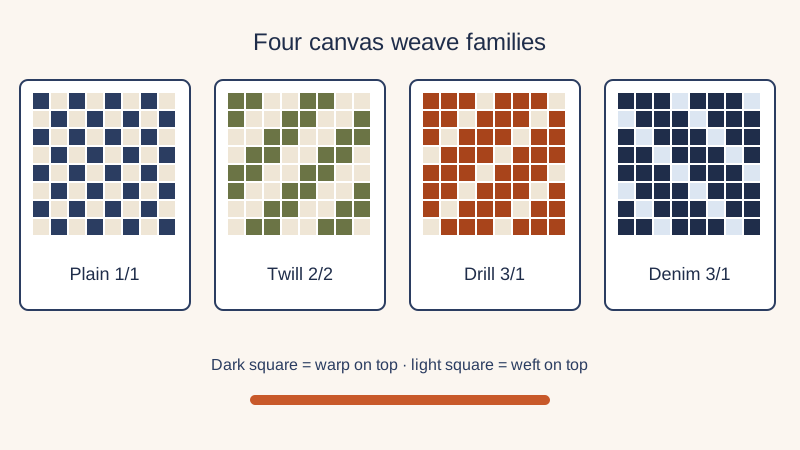
A useful rule is that plain weave gives the best resistance to water and wind for a given weight, while the twill family gives better abrasion behaviour along the diagonal and a softer drape. When a buyer is unsure, we usually weave a short sample in two weaves so the converting team can test both on its own machines.
Canvas cloth types and their specifications
Below are the main qualities we weave for the local trade and for export. Each can be adjusted in width, weight and finish, and we keep the construction records so that a repeat order matches the first one.
Plain canvas, 7 to 24 oz
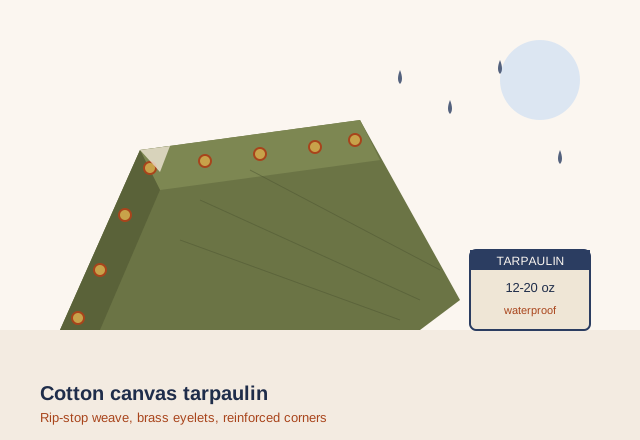
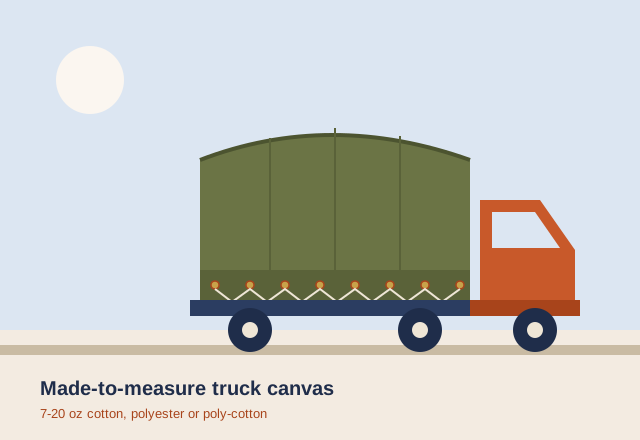
Plain canvas is the backbone of the range and the cloth most of our own canvas tents and tarpaulins are made from. Lighter weights around 7 to 10 oz go into tote bags, linings and craft use; mid weights from 12 to 16 oz suit tents, covers and heavier bags; and the top of the range, up to 24 oz, is used where stiffness and abrasion resistance come first, such as truck covers and industrial sheeting.
Drop cloth
Our drop cloth is woven to the international norms that overseas buyers expect, and most of it is sold abroad. Painters use it to protect floors and furniture, while retailers and home decorators cut it into curtains, slipcovers and rustic table linen. The appeal is an honest, slightly slubby cotton surface that softens with washing.
Ducting cloth
Ducting cloth moves in large volumes to the Middle East. It is woven in several weights, constructions and yarn types, depending on whether the customer needs a backing for flexible duct connectors, an industrial wrapping or a base cloth for later coating. Because the end uses vary so widely, we confirm the exact use before recommending a construction.
Sheeting cloth
Sheeting is a lighter, finer plain-weave cotton used for bed sheets, table covers and ironing-trolley covers. Three standard constructions are listed in the table below.
Half panama
Half panama is a basket-effect cloth that has more texture than sheeting and more body than a shirting. It is popular for aprons, banners, wall hangings and bags, and it takes printing well.
| Quality | Construction | Width | Typical uses |
|---|---|---|---|
| Sheeting | 20×20 / 60×60 | 63" | Bed sheets, table covers |
| Sheeting | 30×30 / 76×56 | 59" | Bed sheets, ironing-trolley covers |
| Sheeting | 30×30 / 76×68 | 59" | Denser sheeting, table linen |
| Half panama | 20×10 / 40×36 | 59" | Aprons, bags, banners |
| Half panama | 20×12 / 40×36 | 59" | Wall hangings, printed bags |
| Quality | Yarn | Weight range | Main markets |
|---|---|---|---|
| Plain canvas | Mostly 7s and 9s | 7–24 oz | Tents, tarps, bags, covers |
| Drop cloth | Coarse cotton | To buyer standard | Export, household use |
| Ducting cloth | Various | Several weights | Middle East, industry |
| Twill / drill / denim | To order | To order | Workwear, bags, covers |
How to read a canvas construction such as 20×10/40×36 59"
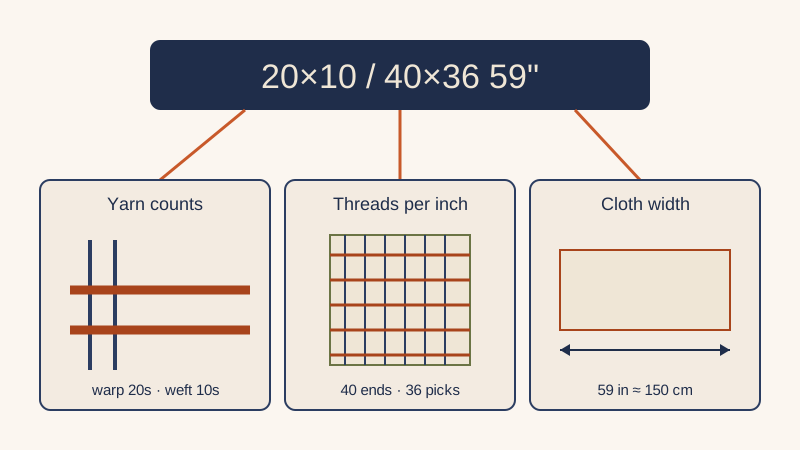
Textile traders compress a whole cloth description into one short string, and it is worth learning to read it because two fabrics of the same weight can behave very differently. Take the half panama quality 20×10/40×36 59" as the example.
- 20×10 are the yarn counts: 20s in the warp (lengthwise threads) and 10s in the weft (crosswise threads). The weft here is twice as thick as the warp.
- 40×36 is the thread density: 40 warp ends per inch and 36 weft picks per inch, counted on the finished grey cloth.
- 59" is the usable width of the fabric in inches, roughly 150 cm.
With those three facts a technician can estimate the weight per square metre, predict how the cloth will shrink, and judge whether it will be stiff or supple. A higher ends-and-picks figure at the same counts gives a tighter, heavier and less porous fabric. Swapping the weft from 10s to 12s, as in our second half panama quality, makes the cloth slightly lighter and smoother while keeping the same density.
When you send us a sample from another mill, we can analyse it and give you the construction string back. That is often the fastest way to replace a cloth you already use.
Ounces versus gsm for canvas fabric weight
Buyers in the Gulf and Africa often ask for weight in grams per square metre, while American and some British customers still think in ounces. One ounce per square yard equals about 33.9 grams per square metre, so the conversion is straightforward as long as both sides agree on the area being measured.
| oz/yd² | gsm | Feel and typical use |
|---|---|---|
| 7 oz | about 240 | Light canvas for totes and linings |
| 10 oz | about 340 | All-round bag and cover cloth |
| 12 oz | about 405 | Tent walls, medium tarpaulins |
| 15 oz | about 510 | Heavy tent roofs, marquee cloth |
| 18 oz | about 610 | Frame tents, heavy tarps |
| 24 oz | about 815 | Very stiff industrial canvas |
The trap to avoid is the linear-yard convention used in some markets, where "ounces" means the weight of one running yard at a stated width rather than one square yard. A 10 oz cloth quoted per linear yard at 60 inches is noticeably lighter per square metre than a 10 oz cloth quoted per square yard. We always write the basis on our pro forma invoice. Remember also that finishing adds weight: a waterproofed canvas can weigh more than the same fabric in the grey, so state whether your target figure is grey or finished.
Finishes and dyeing for cotton canvas cloth
Grey canvas straight off the loom is useful for many converters, but a large share of our cloth is finished before dispatch. Our own dyeing unit uses in-house techniques for fast colours, which is important for olive-green and khaki canvas that will stand in the sun for months.
- Water-impregnated and waterproof finishes that make the canvas shed rain while still letting it breathe, the property that keeps a cotton tent drier inside than a plastic sheet.
- Rot-proof treatment that slows fungal attack when cloth is stored damp or pitched on wet ground.
- Termite-proof finishes for regions where insects destroy untreated cotton in storage.
- Abrasion-resistant and high-temperature-resistant constructions for industrial and hot-climate service.
- Dyed shades including natural white, olive green, khaki, sand and custom Pantone-matched colours on request.
Finishes are agreed per order because each one changes handle, weight and cost. Tell us how the cloth will be used, whether it will be stitched before or after treatment, and the climate where it will end up, and we will suggest a finishing route.
Where our canvas fabric ends up
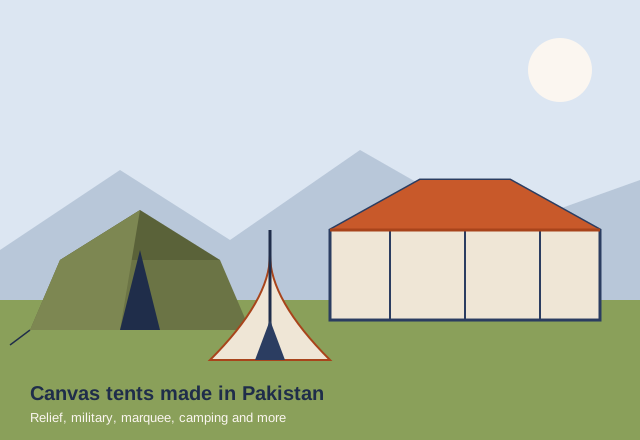
Because we stitch our own products as well as selling cloth, we see the full chain from loom to finished article. Part of our plain canvas stays in-house and becomes tents, tarpaulins and truck canvas. A large share is sold as roll goods to converters who make their own products.
Shelter and covers
Tent makers, tarpaulin stitchers and fabricators of machinery covers buy medium and heavy plain canvas.
Bags and accessories
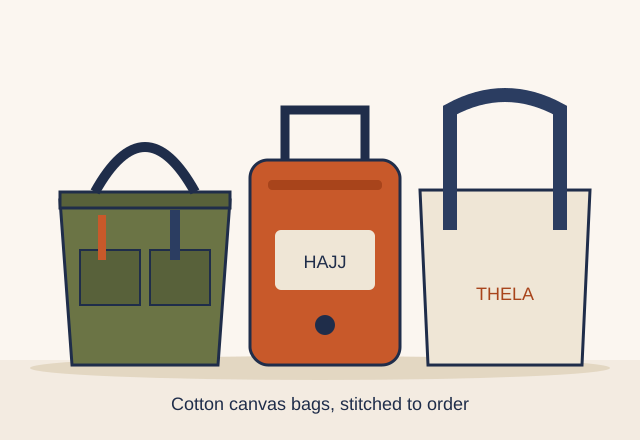
Lighter canvas, half panama and denim-type cloth feed workshops making totes, tool bags and fashion pieces. See our own canvas bags.
Home and hospitality
Drop cloth and sheeting become curtains, bed linen, table covers and ironing-board covers.
Industry
Ducting cloth and heavy duck serve HVAC fabricators, packing applications and coating lines.
If your product mixes canvas with synthetic cloth, our polyester fabrics page covers the PV, PC and pure polyester grey qualities we also weave.
Roll and bale packing for canvas fabric exports
Packing is not an afterthought; it affects freight cost, damage rates and how quickly your warehouse can unload a container. Canvas is normally packed in one of two ways.
Rolls
Cloth is wound onto a cardboard or plastic tube, wrapped in polythene and then in hessian or woven polypropylene. Rolls protect the face of the fabric from creasing, which matters for printing bases, coated cloth and anything that will be cut on an automatic table. Roll length is agreed with the buyer according to the handling equipment at the destination.
Bales
For grey goods and cloth that will be processed further, folded fabric is compressed into bales and strapped. Baling fits more metres into each container and lowers freight per metre, which is why ducting cloth and large grey orders usually travel this way.
Each roll or bale carries a label with quality, construction, shade, length and gross and net weight, and a packing list accompanies the shipment. Our shipment page explains how goods move by sea container, truck, air or courier depending on the urgency and size of the order.
Ordering canvas fabric from Pakistan: samples, lead time and terms
Most orders start with a sample. We can send swatches of standard qualities or weave a sample to your specification, usually within about two weeks. Established customers can receive samples at production prices. After the sample is approved, bulk production normally takes 30 to 45 days depending on quantity and finish.
Minimum order quantities exist and differ by quality, since a loom set-up for heavy duck is not the same as one for sheeting. New customers usually pay by sight L/C or with a 70% advance. Raw cotton yarn is purchased locally in Pakistan, and our own doubling, weaving, dyeing and packing units keep each stage under one management. If a delivered roll is defective, it can be returned for repair or replacement.
To get a quotation, send the construction or the end use, the weight in oz or gsm, width, colour or finish, quantity and destination port to info@curiotex.com, call +92 317 8885522, or use the Send Inquiry page. Haji Ghulam Hasan and the team will reply with options and, where it helps, a sample.
Canvas fabric Pakistan: buyer questions answered
What yarn counts does Curiotex use for heavy canvas fabric?
Our heavier canvas is mostly woven from well-blended cotton in 7s and 9s English counts, either single or doubled on our own twisting frames. Lighter qualities such as sheeting and half panama use finer yarns like 20s, 30s, 10s and 12s. The count is always stated on the quotation so you can compare like with like.
What weight range of plain canvas can you supply?
Plain canvas is produced from about 7 oz up to 24 oz per square yard, roughly 240 to 815 gsm. Lighter weights suit bags and linings, mid weights suit tents and covers, and the heaviest cloth is used for truck covers and industrial sheeting. Tell us whether your target weight is grey or finished.
What does 30×30/76×56 59 inch mean on a sheeting specification?
It means 30s yarn in both warp and weft, 76 warp ends and 56 weft picks per inch, and a cloth width of 59 inches. Our other sheeting qualities are 20×20/60×60 at 63 inches and 30×30/76×68 at 59 inches, the latter being denser and slightly heavier.
Is half panama the same as canvas?
Half panama is a lighter cotton cloth with a basket-like texture, made in our 20×10/40×36 and 20×12/40×36 constructions at 59 inches. It has more body than sheeting but is far lighter than heavy canvas, so it is used for aprons, banners, wall hangings and printed bags rather than tents or tarpaulins.
Do you export ducting cloth?
Yes. Ducting cloth is shipped in large volumes to buyers in the Middle East. We weave it in several weights, specifications and yarn types, so please tell us the end use, for example flexible duct connectors or coating base, and we will propose a suitable construction and packing.
Can the canvas cloth be waterproofed or rot-proofed?
Yes. We can supply water-impregnated, waterproof, rot-proof, termite-proof and abrasion-resistant canvas, and dye it in fast colours such as olive green or khaki. Each finish changes weight and handle, so we confirm the treatment against your use and climate before production. Grey unfinished cloth is also available.
Can you match a canvas sample from another supplier?
Usually yes. Send a swatch of at least an A4 size and we will analyse yarn counts, ends and picks, weave and weight, then weave a matching sample. This is often the quickest route for importers who want to switch mills without changing their finished product.
How is canvas fabric packed for export?
Cloth is supplied either on rolls wrapped in polythene and an outer cover, which protects the surface, or folded and pressed into strapped bales, which saves container space. Each package is labelled with quality, shade, length and weight. Details of freight modes are on our shipment page.
What are the lead time and payment terms for canvas fabric orders?
Samples usually ship within about two weeks. After approval, bulk orders normally take 30 to 45 days depending on quantity and finishing. New customers generally pay by sight L/C or 70% advance. Minimum quantities vary by quality; ask through our inquiry form.