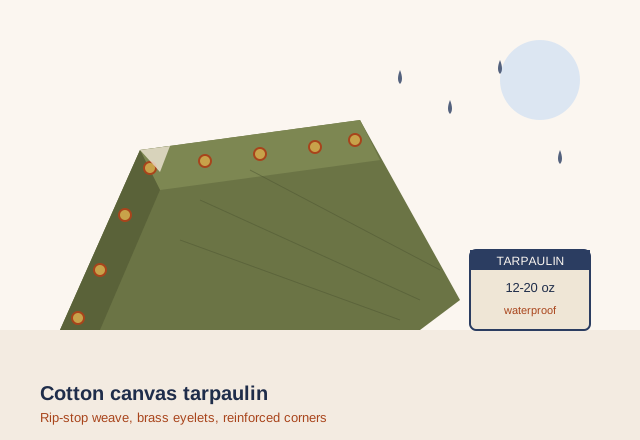
Canvas tarpaulin from Pakistan, woven and finished in-house
Canvas tarpaulin is the second-oldest product line at Curiotex Industries Pakistan, after tents. Every tarp starts as yarn doubled on our own frames, is woven into a rip-stop cotton canvas on our looms, and is then proofed, cut, hemmed, patched and eyeleted in our stitching unit in Kasur. Because the whole chain sits under one roof, a buyer ordering canvas tarpaulin from Pakistan through us is dealing with the mill that controls the cloth, not a trader reselling someone else's rolls.
We produce tarpaulins in a wide range of colours, lengths, widths, mesh constructions and weights. Most export orders fall between 12 and 20 oz per square yard of waterproof canvas, but lighter and heavier cloths can be discussed when the end use calls for it. Buyers can pick from our standard sizes or hand us a drawing with their own measurements; both routes are routine for our cutting floor.
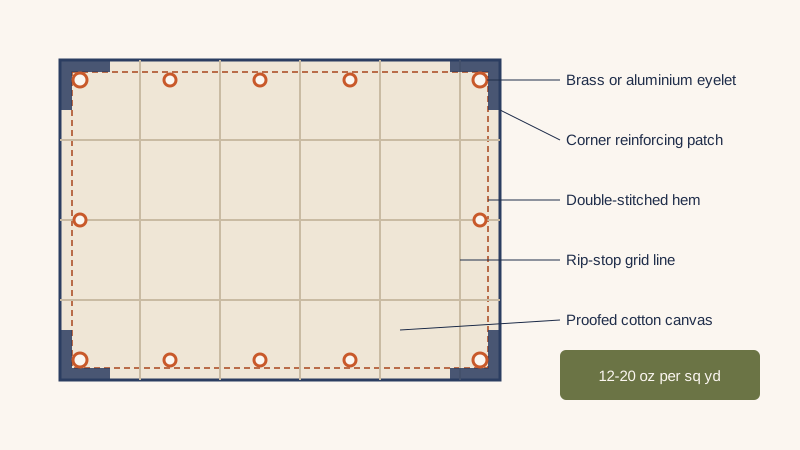
A cotton canvas tarp is a simple object made of three things done properly: a well-defined canvas fabric, a set of brass or aluminium eyelets, and strengthening patches at the points that take load. The rest of this page explains how we handle each of those, how the waterproofing options differ, and how to choose the right specification for your site, warehouse or vehicle.
What a Curiotex cotton canvas tarp is made of
The canvas body
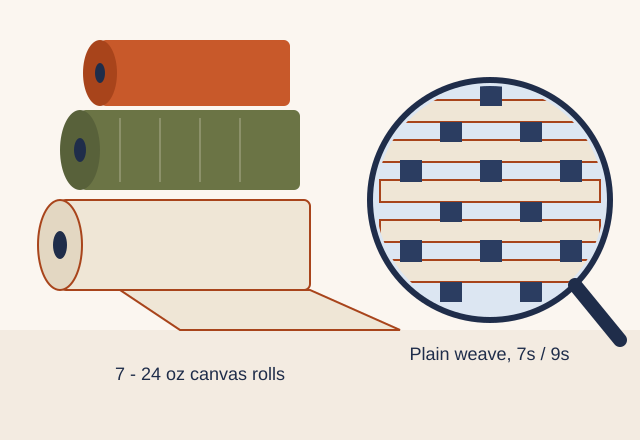
The body of the tarp is a cotton canvas woven with a rip-stop pattern, meaning heavier or doubled yarns are inserted at regular intervals in both warp and weft. If the sheet is punctured by a nail or the corner of a crate, the tear tends to stop at the next reinforcing line instead of running across the whole width. Our yarn is twisted (doubled) in-house before weaving, which gives a rounder, stronger thread and a tighter, more even surface for the proofing chemicals to bond to.
Hems and seams
Edges are turned and double-stitched so the eyelets punch through several layers of cloth rather than one. Where a tarp is wider than our loom width, panels are joined with overlapping seams that are stitched with strong thread and positioned so that rain runs across them rather than into them. Seam layout is something we agree with the buyer on large custom sheets.
Eyelets and reinforcing patches
Brass eyelets are the traditional choice for cotton canvas because they resist corrosion and hold their grip in thick cloth. Aluminium eyelets are lighter and also corrosion resistant, and suit buyers who want to keep weight down on very large sheets. Corners, and any intermediate tie points you specify, are backed with additional canvas patches stitched in before the eyelet is set, so the pull of a rope is spread over a wider area instead of concentrating on the hole.
Standard canvas tarpaulin sizes and weights
The table lists our standard finished sizes. Each can be ordered in any of the canvas weights we stock for tarps, typically 12 to 20 oz, and in natural, olive, khaki or other colours by arrangement. If none of these sizes suits your stacks or vehicles, we cut to order.
| Size (feet) | Approx. size (metres) | Area (sq ft) | Typical use |
|---|---|---|---|
| 12' x 9' | 3.66 x 2.74 | 108 | Small machinery, pallets, market stalls |
| 15' x 12' | 4.57 x 3.66 | 180 | Generators, small stacks, pickup loads |
| 18' x 12' | 5.49 x 3.66 | 216 | Material piles, open sheds, light vehicles |
| 21' x 15' | 6.40 x 4.57 | 315 | Grain or cement stacks, scaffolding sections |
| 24' x 18' | 7.32 x 5.49 | 432 | Construction sites, larger stacks |
| 27' x 18' | 8.23 x 5.49 | 486 | Warehouse yards, roofing cover |
| 27' x 24' | 8.23 x 7.32 | 648 | Bulk storage, factory yards |
| 33' x 27' | 10.06 x 8.23 | 891 | Large stacks, chemical storage sheds |
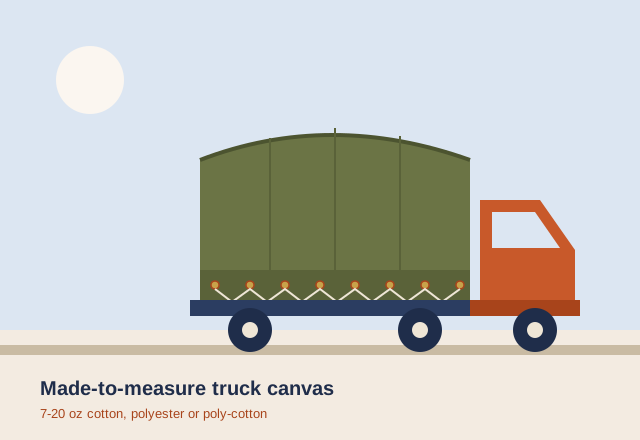
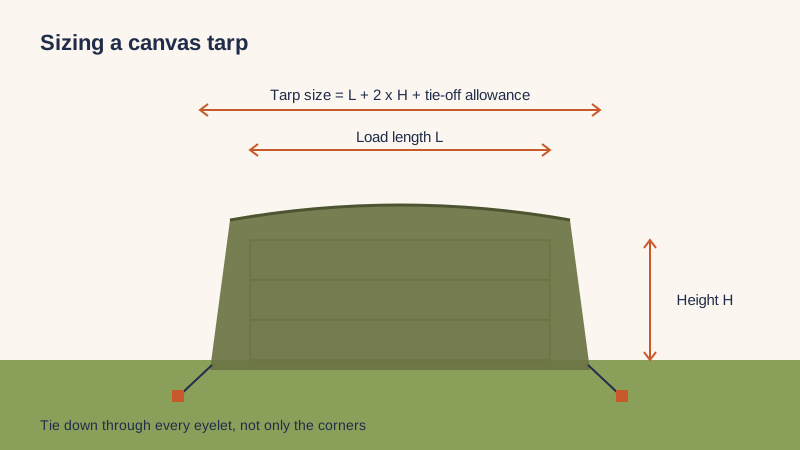
Remember that a tarp needs to hang down the sides of whatever it covers and still leave enough cloth to tie off. For a stack, add twice the stack height plus roughly half a metre to each plan dimension before picking a size. For truck bodies, the cover is a tailored product; see our dedicated truck canvas covers page.
Understanding canvas weight: ounces versus gsm
Tarpaulin buyers in the Middle East and Africa often quote weights in ounces, while relief agencies and European importers usually speak in grams per square metre (gsm). Both measure the same thing, the mass of cloth per unit of area, just in different units. One ounce per square yard is about 33.9 grams per square metre. The conversion is simple: 1 oz is 28.35 g, and one square yard is 0.836 square metres, so 28.35 divided by 0.836 gives roughly 33.9.
| Ounces per sq yard | Approx. gsm | Feel and typical role |
|---|---|---|
| 12 oz | 407 | Medium weight; general covers that are handled often |
| 14 oz | 475 | Good all-round tarp for sites and yards |
| 16 oz | 542 | Heavy duty; long outdoor exposure |
| 18 oz | 610 | Very heavy; abrasion against loads or structures |
| 20 oz | 678 | Heaviest standard tarp; semi-permanent covers |
Ask whether a quoted weight is for grey (unfinished) cloth or for finished, proofed canvas. Waterproofing adds mass, so a cloth woven at one weight finishes heavier. When you send an inquiry, state which figure you mean and we will confirm the matching specification in writing.
Weight is a useful shorthand for strength and durability, but it is not the whole story. Yarn count, weave density and the quality of the twist all affect tear and tensile strength. Two tarps of identical gsm can behave quite differently if one is woven loosely from heavier yarn and the other tightly from finer, well-doubled yarn. That is why we prefer to agree a full specification, not just a number.
Waterproofing options: chemical proofing or wax coating
Cotton fibres swell when wet, which closes the gaps in a dense weave, but raw canvas alone will still let water through under steady rain. Every tarp we sell is therefore treated. We offer two main routes, and the right one depends on how the tarp will be used and handled.
Chemically waterproofed canvas
The cloth is passed through a water-repellent chemical finish that penetrates the fibres. The result stays relatively flexible and breathable, keeps a cleaner surface and is easier to fold and handle. It suits covers that are moved regularly, goods that can sweat under impermeable sheets, and buyers who want a drier hand feel. Rot-proof additives can be combined with the proofing.
Wax-coated canvas
A wax-based dressing is applied to the canvas, leaving a coating that sheds water strongly and stiffens the cloth. Wax tarps are favoured for long, static outdoor exposure such as stack covers in rainy seasons. They are heavier, have a slightly tacky surface and need cooler storage, but give a very firm barrier against driving rain.
On request we can also apply finishes against rot and mildew, and the factory is able to produce termite-proof, abrasion-resistant and high-temperature-resistant canvas for demanding sites. These finishes are specified at the inquiry stage because they change the processing route, so mention them early. Colour fastness is handled in our own dyeing unit, which uses techniques developed for firm colours that hold up under sun and rain.
Polyester-cotton and HDPE tarpaulin alternatives
Pure cotton is not the only option. Alongside our cotton line we supply polyester-cotton tarpaulins, which are chemically waterproofed in the same way. Blending polyester into the yarn raises strength for a given weight, reduces shrinkage and helps the cloth dry faster, while the cotton component keeps the breathable, easy-to-handle character buyers expect from canvas. Poly-cotton is a sensible middle path when weight matters, for instance on covers that a single worker must lift.
For buyers who need a fully impermeable, lightweight, low-cost sheet, we also supply HDPE tarpaulins. These woven high-density polyethylene sheets are coated to be completely waterproof and are common for short-term cover and emergency use. They do not breathe and are less resistant to long sun exposure than proofed canvas, so we generally recommend them for temporary jobs and canvas for anything expected to last several seasons.
| Property | Cotton canvas | Polyester-cotton | HDPE |
|---|---|---|---|
| Breathability | High | Moderate to high | None |
| Weight for strength | Heaviest | Lighter | Lightest |
| Condensation under cover | Low | Low | Can be high |
| Repairability | Easy to patch and restitch | Easy | Tape or heat repair only |
| Best for | Long service, breathable storage | Frequent handling | Short-term, low-cost cover |
Where canvas tarpaulins earn their keep
Our tarps go to construction sites, small and large businesses, factories, and chemical storage sheds, where they shield goods and equipment from water, damp and dust. A few typical jobs:
- Covering cement bags, timber, steel and finished goods stacked in open yards during rain.
- Protecting machinery, generators and compressors parked outdoors between shifts.
- Screening scaffolding and partly built structures from wind-blown dust.
- Lining or roofing temporary sheds and covering drums in chemical storage areas.
- Shading market stalls, loading bays and workshop extensions.
- Providing ground cover and extra roofing for relief camps alongside refugee tents.
Because cotton canvas breathes, it is particularly well suited to agricultural produce and other goods that can sweat under a plastic sheet. Moisture vapour escapes through the cloth, which reduces mould and spoilage in grain or fodder stacks compared with an impermeable cover.
How to specify canvas tarpaulin for your order
- Define the job. What will be covered, for how long, and how often will the tarp be moved? Static long-term covers lean toward heavier wax-coated canvas; frequently handled covers toward chemically proofed or poly-cotton.
- Measure and add drop. Take the length and width of the load and add twice its height plus a tie-off allowance on each dimension. Round up to the nearest standard size or ask for a custom cut.
- Pick a weight. 12 to 14 oz suits general use; 16 to 20 oz suits abrasion, wind exposure and multi-season use.
- Choose eyelets. Brass for durability, aluminium for lighter sheets. Specify spacing (for example every 50 cm or every 2 ft) and any intermediate tie points.
- Add finishes. Rot-proof, mildew-resistant, colour, or special finishes such as abrasion or heat resistance.
- State quantity and packing. Pieces per size, bale or carton packing, and labelling requirements.
Send this information through our inquiry form or by email to info@curiotex.com, and our team will reply with a confirmed specification. If you are unsure, describe the job in plain words; guiding clients toward the right choice is part of how we work.
Caring for a cotton canvas tarp
A well-made canvas tarpaulin can last many seasons with modest care. The biggest enemy is being packed away wet, which invites mildew even on rot-proofed cloth. Spread the tarp out to dry in the air before folding, and store it off the floor in a cool, ventilated place. Wax-coated tarps in particular should be kept away from strong heat, which can soften the dressing.
Avoid dragging the sheet across rough concrete, and pad sharp edges on loads with sacking or old canvas so they do not wear through under wind movement. Tie down through every eyelet rather than only the corners; spreading the load stops any single eyelet from tearing out. Small cuts can be patched with a piece of the same canvas stitched or glued in place, and reproofing compounds can refresh the water repellency after long service. Detergents strip proofing, so clean with plain water and a soft brush.
Ordering canvas tarpaulin for export from Pakistan
We supply both local Pakistani buyers and importers abroad, especially in the Middle East and West Africa. Tarps are folded and baled or cartoned in our packing unit, which matters more than many buyers expect: tight, consistent packing reduces freight cost and keeps sheets clean in transit. Shipments can travel by sea container, truck, air or courier depending on urgency and size; our shipment page covers the modes.
For new customers our usual payment terms are a sight L/C or 70% advance. Lead time is usually 30 to 45 days from sample or specification approval, depending on quantity. Samples are available and generally ship in about two weeks, and we can develop a sample to your own design. Minimum order quantities vary by size and finish, so please ask. If you also need the base cloth for your own fabrication, see our canvas fabric range, and for related products browse the full products overview.
To discuss an order, call +92 317 8885522 or email info@curiotex.com and ask for Haji Ghulam Hasan.
Canvas tarpaulin Pakistan: buyer questions
What weights of canvas tarpaulin do you make?
Our standard waterproof canvas for tarpaulins runs from 12 oz to 20 oz per square yard, which is roughly 407 to 678 gsm. Lighter cloth suits covers that are lifted by hand every day, while 16 to 20 oz is chosen for long outdoor exposure, wind and abrasion. Tell us the job and we will suggest a weight.
Which standard tarpaulin sizes are available?
We keep eight standard sizes: 12x9, 15x12, 18x12, 21x15, 24x18, 27x18, 27x24 and 33x27 feet. All are hemmed, eyeleted and patched at the corners. Any other dimension can be cut to order, including very large sheets joined from several panels.
What is the difference between chemically waterproofed and wax-coated tarps?
Chemical proofing penetrates the fibres and leaves the canvas flexible, breathable and clean to handle, which suits covers that are folded and moved often. Wax coating sits more on the surface, sheds water very strongly and stiffens the cloth, which suits static covers left outdoors through long rainy spells. Wax tarps are heavier and prefer cool storage.
How do I convert ounces to gsm for tarpaulin canvas?
Multiply the ounces per square yard by about 33.9. For example, 14 oz is roughly 475 gsm and 18 oz about 610 gsm. Also confirm whether the figure refers to grey cloth or finished canvas, since waterproofing adds weight to the final sheet.
Do you use brass or aluminium eyelets?
Both are available. Brass is the classic choice for heavy cotton canvas and holds very firmly; aluminium is lighter and also resists corrosion. Corners and any tie points you specify are backed with extra canvas patches before the eyelet is fitted, so ropes pull against several layers of cloth.
Can you make HDPE or polyester-cotton tarpaulins instead of cotton?
Yes. We supply chemically waterproofed polyester-cotton tarpaulins, which are lighter and shrink less than pure cotton, and HDPE tarpaulins for low-cost, fully impermeable short-term cover. For multi-season use or goods that need to breathe, we still recommend cotton canvas.
Are your tarps rot-proof and suitable for chemical storage areas?
Rot-proof and mildew-resistant finishes can be added to our canvas, and the factory can also produce abrasion-resistant, termite-proof and high-temperature-resistant cloth. Tarps are widely used in chemical storage sheds for protection from rain, damp and dust. Please describe the chemicals and conditions so we can advise on a suitable finish.
What is the lead time and minimum order for canvas tarpaulins?
Production usually takes 30 to 45 days after the sample or specification is approved, depending on quantity. Minimum order quantities vary with size, weight and finish, so share your requirements through the inquiry form and we will confirm the MOQ.
Can I get a tarpaulin sample before ordering?
Samples are available and usually ship in about two weeks. We can also develop a sample to your own drawing or specification. For well-established customers, samples are offered at production prices.
How are tarpaulins packed for export?
Tarps are folded to a consistent size and packed in bales or cartons by our packing unit, with labels and marks as you require. They can travel by sea container, truck, air freight or courier. Compact packing keeps freight costs down and protects the sheets from dirt in transit.