Store tents Pakistan relief agencies and armies rely on
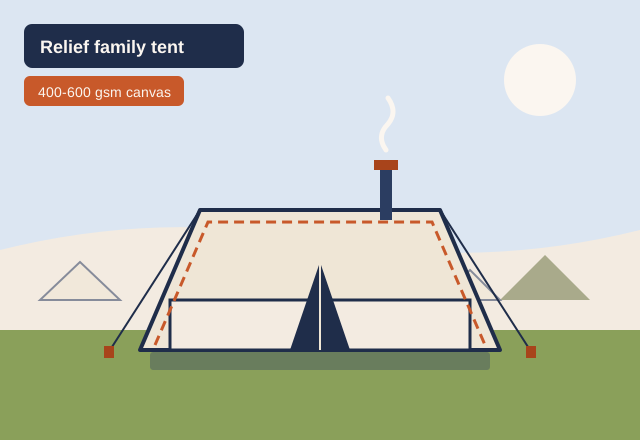
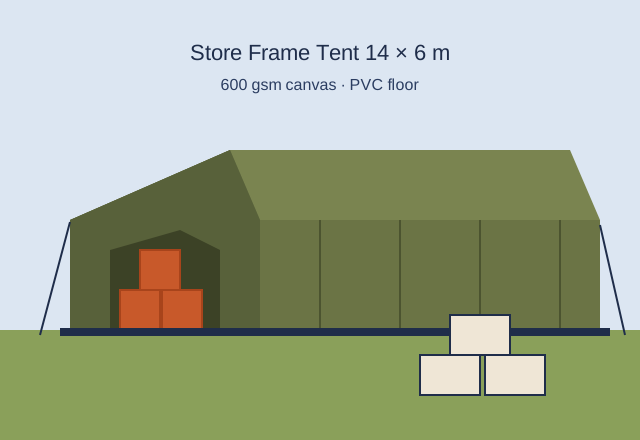
When food, medicine, shelter kits or spare parts arrive at a site faster than permanent buildings can be found, they still need a dry, secure roof. That is the job of a store tent. Curiotex Industries Pakistan manufactures store tents in Pakistan in the form of a heavy-duty Store Frame Tent: a large rectangular canvas building supported on a metal frame, with a fitted PVC groundsheet that keeps stock off the soil.
We have woven and stitched canvas since 1975, and the store tent uses our heaviest tent cloth, 600 gsm waterproof cotton canvas. It is designed as a winter store tent for long use in harsh weather, which is why buyers in emergency logistics, military supply and construction choose it over lighter shelters. The same frame is also used as a field hospital ward, and our hospital tent page covers that application.
This page sets out the specifications, explains how the frame and floor work, and gives practical advice on site preparation, ventilation and stacking so the goods inside stay in good condition. For a quotation, send your quantity and destination through our inquiry form.
Store frame tent specifications
| Item | Specification |
|---|---|
| Fabric | Waterproof cotton canvas, 600 gsm |
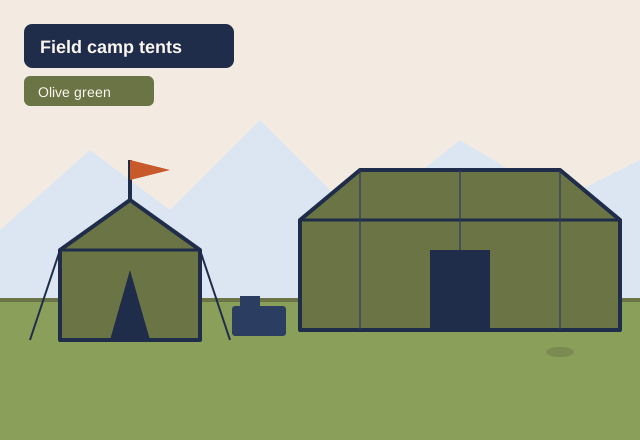
| Colours | Natural white or olive green |
| Standard size | 14 m × 6 m |
| Alternative version | 12 m × 6 m (synthetic version) |
| Height at ridge | 3.6 m |
| Wall height | 2 m |
| Floor | Fitted PVC groundsheet |
| Accessories | Metal poles and frame, iron pegs, carry bag |
| Intended service | Long-term storage in harsh and winter weather |
Specifications can be adjusted on request, for example colour, additional doors or special finishes such as rot-proof or termite-proof treatment of the canvas. We will always confirm changes in writing on the pro forma invoice.
Floor area and storage capacity
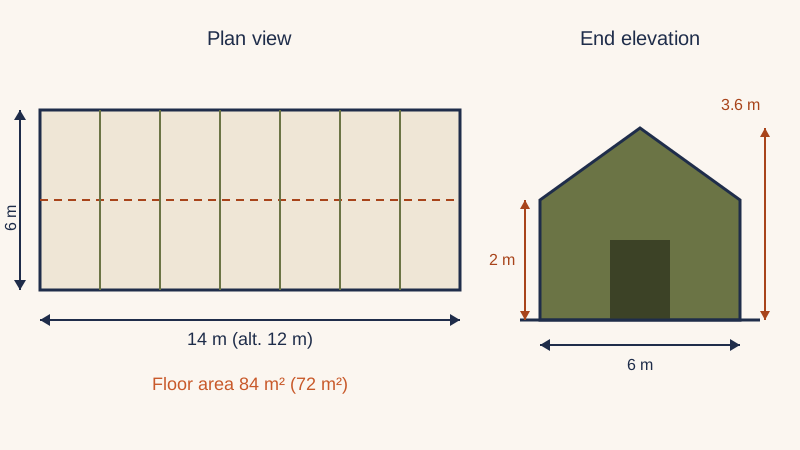
The 14 × 6 m tent covers 84 m² of floor, and the 12 × 6 m alternative covers 72 m². Because the walls rise vertically to 2 m before the roof slopes up to 3.6 m at the ridge, almost the whole footprint is usable to shoulder height, and the central strip offers more headroom still.
How much fits inside depends on what you store and how high you stack, so we avoid quoting a single capacity figure. A useful planning approach is:
- Start from the floor area (84 m² or 72 m²).
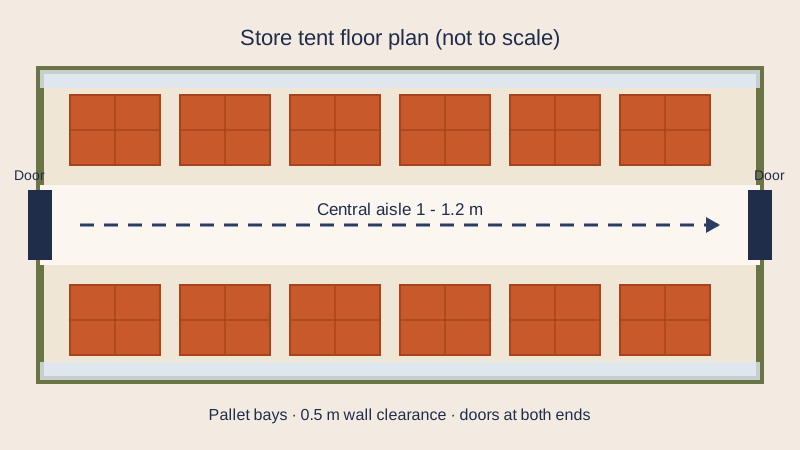
- Subtract aisles. A 1 to 1.2 m central walkway for hand trucks and inspection usually leaves around 65 to 70 m² of stacking area in the larger tent.
- Keep stacks about 0.5 m clear of the canvas walls so air can move and condensation on the fabric does not wet the cartons.
- Multiply the remaining area by a safe stack height. Below the 2 m walls, stacks of around 1.8 m are practical; under the ridge they can go higher if the goods allow.
Store managers often divide the floor into labelled bays so that incoming and outgoing stock can be tracked on a simple bin card. That layout also makes it easier to apply first-in, first-out rotation for food and medicines.
How the frame structure works
Unlike a pole-and-guy-rope tent, a frame tent stands on a rigid skeleton of metal poles. Upright legs along each side carry roof rafters that meet at a ridge, and the canvas is then drawn over and tied to the frame. The advantages for storage are significant.
- Unobstructed interior: there are no centre poles in the way of pallets, shelving or stacking.
- Vertical walls: goods can be stacked right up to the wall line without pushing against sloping fabric.
- Less reliance on guy ropes: the frame carries most of the load, so the tent needs a smaller cleared area around it than a guyed marquee, which matters in crowded camps and depots.
- Easy relocation: the frame can be taken down, bundled and moved by truck as operations shift.
Iron pegs anchor the frame feet and the lower edge of the canvas. In very exposed sites, extra storm ropes or ground anchors can be added; ask us if your location is known for strong winds.
Why 600 gsm canvas suits winter and long-term storage
Our store tent uses the heaviest canvas in our tent range, 600 gsm. Heavier cotton canvas has three practical benefits for a store: it is slower to tear if snagged by a forklift tine or a sharp crate corner, it blocks more sunlight so stock stays cooler in summer, and it holds up to the weight and abrasion of snow and freezing wind in winter.
Cotton canvas also breathes. A properly waterproofed cotton fabric sheds rain because the fibres swell when wet and close the weave, yet it still lets water vapour pass. In a closed plastic shelter, moisture given off by the ground, the goods and the people working inside condenses on the roof and drips back down; in canvas that effect is much smaller, which is a real advantage when storing flour, rice, paper or cardboard-packed supplies.
The cloth is woven, dyed and stitched in our own Curio Units, and we can add rot-proof, termite-proof and abrasion-resistant finishes for tents that will stand for long periods. More detail on our tent fabrics is on the canvas fabric page.
Fitted PVC groundsheet and protection from damp
Rising damp is one of the main causes of spoiled stock in temporary stores. The store frame tent therefore comes with a fitted PVC groundsheet that forms a waterproof floor. PVC is easy to sweep and wipe, resists puncture from pallets and boxes better than light polyethylene, and stops moisture creeping up from the soil into cartons and sacks.
Even with a good floor, we recommend raising goods on pallets or timber dunnage. This gives a second line of defence if water enters under a door during a storm, lets air circulate under the stock, and makes inspection for pests easier.
Never pitch a store tent in a hollow. Even a well-sealed floor cannot protect goods if surface water pools around the tent after heavy rain.
Site preparation and pitching a store tent
A store tent stays up for months, so the time spent preparing the ground pays back many times over.
- Choose the site. Pick level, firm ground on slightly higher land, away from drainage lines and flood-prone areas, with truck access to at least one end.
- Clear and level. Remove stones, roots and sharp debris that could cut the groundsheet. Compact soft soil.
- Dig a drainage trench. A shallow trench just outside the footprint carries rainwater away; lead it downhill.
- Mark the footprint. Peg out a rectangle of 14 × 6 m (or 12 × 6 m) and check the diagonals are equal so the frame sits square.
- Assemble the frame. Join the legs, rafters and ridge on the ground, then raise sections with enough people to keep them steady.
- Fit the canvas and floor. Draw the roof and walls over the frame, tie off evenly, lay the PVC groundsheet and peg the lower edges.
- Tension and inspect. Adjust ties until the canvas is taut with no pockets where rain could pool.
Check tension and pegs after the first rain, because cotton canvas tightens when wet and relaxes as it dries.
Ventilation and stacking goods inside
Good airflow keeps a store tent dry and cooler, and it reduces the risk of mould. Open doors at both ends on dry days to create a through-draught, and keep any ventilation openings clear of stacked goods. In hot climates, light natural white canvas reflects more of the sun's heat than olive green; in military or security settings olive may be preferred for low visibility.
Stacking practice
- Place heavy items at the bottom and on pallets; keep liquids below dry goods.
- Leave a gap between stacks and canvas walls.
- Group stock by type and expiry date, with clear labels facing the aisle.
- Keep a fire extinguisher at each door and do not store fuel with food.
- Inspect the roof after snow or heavy rain and clear any build-up promptly.
Maintenance, repair and dismantling of store tents
A store tent that is looked after can serve for several seasons, then be packed away and redeployed. Routine care is mostly a matter of regular inspection. Walk around the tent each week and look at the ties, pegs and frame joints, especially after storms. Tighten loose ties, re-drive lifted pegs and replace any bent fittings before they let the canvas flap, because flapping fabric wears quickly at the seams.
Small tears or holes in cotton canvas can be patched with a piece of the same cloth stitched or glued over the damage; a local tailor or tent repairer can do this on site. Larger damage is better repaired by re-stitching a full panel. Keep the PVC groundsheet clean and check it for cuts where pallets are moved, since a small puncture lets damp in under the stock.
Taking the tent down
Strike the tent on a dry day whenever possible. Brush off soil and leaves, and if the canvas has to be packed wet, unpack and air it as soon as conditions allow, since damp cotton folded for days can develop mildew even with a rot-proof finish. Count and bundle the frame poles by type, store pegs separately so they do not puncture the fabric, and roll the groundsheet rather than folding it sharply. Stored dry, off the ground and away from rodents, the tent will be ready for the next emergency.
Military, logistics and relief applications
Store tents fill several roles in the field. Military units use them as quartermaster stores, ration depots and vehicle-spares stores at forward bases. Relief agencies set them up as distribution warehouses near camps, where tents, blankets, hygiene kits and food are held before hand-out. Contractors use them on remote construction sites to shelter cement, tools and equipment. Because the frame offers clear floor space, the same tent can also serve as a workshop, dispensary or temporary ward.
Buyers often combine store tents with accommodation shelters in one order. Our military tents, refugee tents and general purpose shelter tents are made from the same family of canvas and can share a container. For covering goods outdoors around the store, our canvas tarpaulins are a practical complement.
Ordering store tents from Pakistan
Store tents are supplied with metal poles, iron pegs, a carry bag and the fitted PVC groundsheet, packed for transport by sea container, truck, air or courier. Our shipment page explains the options. Lead time is usually 30 to 45 days from product approval depending on quantity, and samples can be arranged. New customers normally pay by sight L/C or 70% advance, and minimum order quantities apply.
To request a quotation, send the number of tents, size (14 × 6 m or 12 × 6 m), colour, any special finishes and the delivery destination to Haji Ghulam Hasan at info@curiotex.com or call +92 317 8885522. You can also use the Send Inquiry page or visit our Lahore office.
Store tents Pakistan: questions from procurement teams
What sizes of store tent do you make?
The standard Store Frame Tent is 14 m long and 6 m wide, giving 84 m² of floor. An alternative synthetic version measures 12 × 6 m, or 72 m². Both have 2 m vertical walls and 3.6 m height at the ridge. Other dimensions can be discussed on request.
What fabric is used for the store tent?
It is made from 600 gsm waterproof cotton canvas, the heaviest cloth in our tent range, in natural white or olive green. The canvas is woven, dyed and stitched in our own units, and rot-proof or termite-proof finishes can be added for long-term deployments.
Is a groundsheet included?
Yes. The store frame tent is supplied with a fitted PVC groundsheet that forms a waterproof floor and keeps damp from rising into stored goods. We still recommend placing stock on pallets or dunnage for extra protection and airflow.
Can the store tent be used in winter and snow?
It is designed as a winter store tent for long use in harsh weather. The heavy 600 gsm canvas and metal frame resist wind and abrasion, but snow should be cleared from the roof after heavy falls, and pegs and ties should be checked regularly.
How many people are needed to pitch a 14 × 6 m store tent?
A frame of this size needs a small team rather than one or two people, because rafters and roof sections must be held steady while they are joined and the heavy canvas has to be drawn over evenly. First-time crews should allow extra time. Clearing, levelling and trenching the site beforehand makes pitching faster and safer.
What is the difference between a store tent and a marquee?
A store tent hangs its canvas on a rigid metal frame with vertical walls and no centre poles, giving clear floor space for stacking. A traditional marquee relies on poles and guy ropes. For pole-supported options see our marquee tents.
Can the same tent be used as a field hospital or workshop?
Yes. The Hospital/Store Frame Tent shares the same 600 gsm canvas and frame, and its clear interior suits wards, dispensaries and workshops as well as storage. Many buyers order one model for several roles at a site.
What is the lead time and how is payment handled?
Production usually takes 30 to 45 days from product approval, depending on quantity. New customers generally pay by sight L/C or 70% advance. Minimum order quantities apply. Use our inquiry form to receive a quotation.
How are store tents packed and shipped?
Each tent is supplied with its metal poles, iron pegs, carry bag and PVC groundsheet, with poles and accessories bundled for transport. Shipments travel by sea container, truck, air freight or charter depending on urgency and destination.