Refugee tents Pakistan buyers rely on
When a flood, earthquake or conflict forces families out of their homes, the first need is a roof that keeps out sun, rain and cold from the first night. Our refugee tents Pakistan range was developed for exactly that moment. Curiotex Industries Pakistan has been weaving canvas and stitching tents in Kasur since 1975, and emergency relief tents are the product we treat as our export priority. Relief agencies, NGOs, government disaster authorities and traders in the Middle East and West Africa buy these shelters from us because the fabric, the stitching and the packing all happen under one roof.
The range covers seven models. Four are household shelters (two family ridge tents, a single-pole tent built to the widely used UNHCR family-tent pattern, and a winterized tent). Two are larger frame tents meant for clinics, dispensaries and stores inside a camp. The seventh, the African refugee tent, is a heavy square design with a thicker roof for hot, bright regions. Every model can be adjusted in colour, size or fabric weight when a programme has its own specification.
Besides relief shelters, the same production line also turns out wedding tents, waterproof utility tents and display tents, and we develop custom designs from a buyer's drawing. If you are comparing the full family of products, our canvas tents overview is a good starting point.
Family ridge tents: single fly and double fly
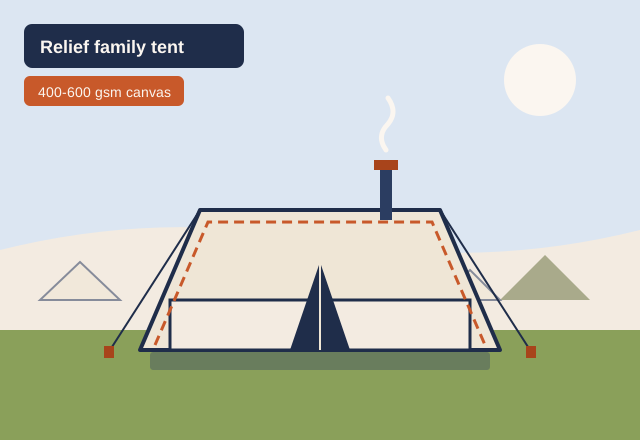
The ridge tent is the classic household relief shelter: two upright poles carry a ridge, the roof slopes down to short side walls, and guy ropes hold the shape. It is quick to pitch, light enough to carry by two people, and familiar to field staff almost everywhere.
Family Ridge Tent – Single Fly
The single-fly version is one layer of cotton canvas at 400 or 450 gsm, dyed natural white or olive green. It comes with metal poles and iron pegs and is packed as a roll. A separate flysheet and a groundsheet can be added when the budget allows. This is the most economical way to shelter a family in a mild climate or for a short deployment.
| Capacity | Floor size | Ridge height | Wall height |
|---|---|---|---|
| 4 persons | 4 × 2 m | 2 m | 0.75 m |
| 6 persons | 4 × 3 m | 2 m | 0.75 m |
| 8 persons | 4 × 4 m | 2 m | 0.75 m |
Family Ridge Tent – Double Fly
The double-fly tent adds a second canvas roof held a few centimetres above the first. That air gap is what makes the difference: under strong sun the outer fly takes the heat and the inner roof stays noticeably cooler, and in rain the outer layer sheds water before it can wick through. The tent is supplied with poles, pegs and a carry bag. Options include an inner tent with lining and a stove pipe opening, plus a groundsheet. A larger 12-person size is offered in this version.
| Capacity | Floor size | Ridge height | Wall height |
|---|---|---|---|
| 4 persons | 4 × 2 m | 2 m | 0.75 m |
| 6 persons | 4 × 3 m | 2 m | 0.75 m |
| 8 persons | 4 × 4 m | 2 m | 0.75 m |
| 12 persons | 6 × 4 m | 2 m | 0.75 m |
Rule of thumb from the field: choose single fly for short summer deployments where cost per family matters most, and double fly whenever the tent may still be standing through a rainy season or a winter.
UNHCR-pattern double fly single pole tent
Many relief programmes specify a square family tent with a single central pole, a high peak and tall walls. Our version is built to the widely used UNHCR family-tent pattern; it is not a UN-approved or UN-supplied product, and we say so plainly so procurement officers can evaluate it on its specification. The outer fly is larger than the inner tent, which leaves a walkway of shade and an insulating air layer all around the living space.
Fabric is 400 or 450 gsm cotton canvas. Standard supply includes poles, pegs and a bag; an inner lining, a stove pipe opening and a groundsheet are optional.
| Part | Size | Centre height | Wall height |
|---|---|---|---|
| Inner tent | 4 × 4 m | 2.75 m | 1.8 m |
| Outer fly | 4.5 × 4.5 m | 3 m | 2.05 m |
With 16 m² of covered floor and walls that let adults stand near the edges, this design suits a household of five to six people for a long stay. The tall walls are the main reason camp managers prefer it over a ridge tent: usable space is far greater than the floor size alone suggests.
Winterized refugee tent for cold regions
For mountain districts, high plateaux and northern winters, a standard relief tent loses heat too fast. Our winterized tent is a dedicated cold-weather design in 400 or 450 gsm canvas, supplied with poles, pegs, a bag and a PVC groundsheet as standard, because cold rising from the ground is as serious as wind on the walls.
| Part | Size | Height | Wall |
|---|---|---|---|
| Inner | 4.05 × 4.05 m | 3.4 m | 2.5 m |
| Outer | 4.1 × 4.1 m | 2.5 m | 1.5 m |
How winterization works
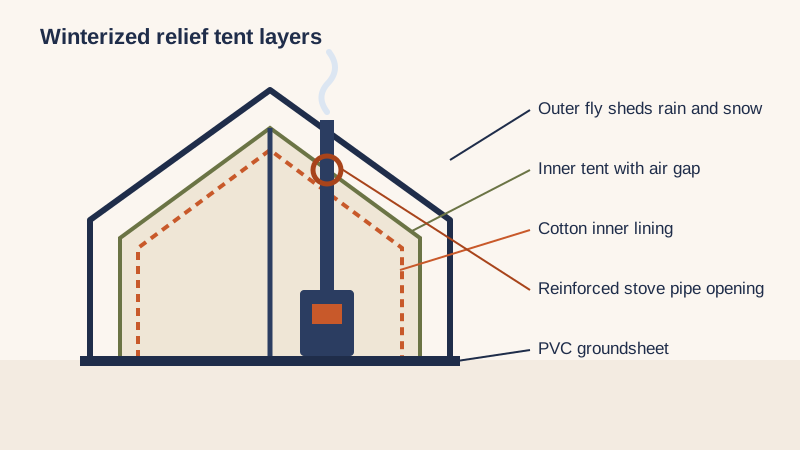
- Inner lining: a cotton lining stitched or tied inside the roof and walls traps a still air layer, the cheapest insulation available.
- Stove pipe opening: a reinforced ring in the roof lets a family use a small heater or stove with the flue passing safely outside the canvas. The ring is reinforced so hot pipe never touches bare fabric.
- Sealed ground contact: a PVC groundsheet stops damp and ground cold, and snow-sod flaps can be weighted down to block draughts.
- Double layers: the outer fly sheds snow and rain while the inner tent stays dry.
The stove pipe opening and inner lining are also available on the double-fly ridge tent and the UNHCR-pattern tent, so an agency can winterize stock it already uses rather than switch models.
Frame tents for clinics, dispensaries and camp stores
A camp needs more than family shelters. Food and non-food items must be stored, patients must be seen, and registration needs a covered hall. Three of our relief models are built around these communal tasks.
Hospital/Store Frame Tent
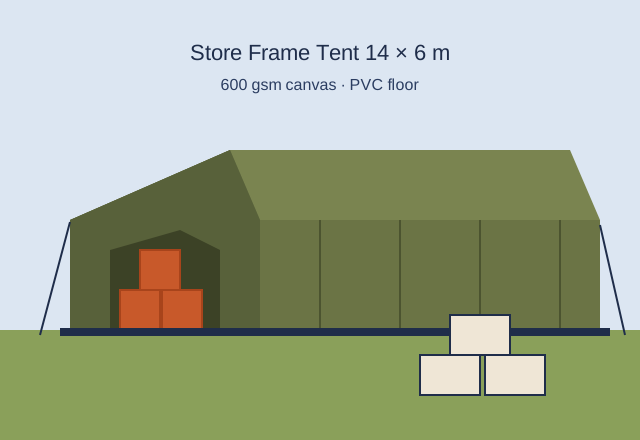
Heavy 600 gsm canvas over a frame, 14 × 6 m (an alternative version is 12 × 6 m), height 3.6 m, walls 2 m. Supplied with poles, pegs, bag and PVC groundsheet. Used as a ward, warehouse or distribution hall. See also our store tents.
Dispensary Frame Tent
500 gsm waterproof, rot-proof canvas, 5 × 5 m, height 2.7 m, walls 1.83 m. Works as a dispensary, a small store or a hospital annex. Optional PVC groundsheet.
African Refugee Tent
A roof of 500–525 gsm with 450 gsm walls, waterproof and rot-proof, 5 × 5 m, height 2.7 m, walls 1.83 m. Optional PVC groundsheet. A heavier roof for strong sun and seasonal storms.
| Model | Fabric | Size | Height | Wall |
|---|---|---|---|---|
| Hospital/Store Frame Tent | 600 gsm | 14 × 6 m (or 12 × 6 m) | 3.6 m | 2 m |
| African Refugee Tent | Roof 500–525, walls 450 gsm | 5 × 5 m | 2.7 m | 1.83 m |
| Dispensary Frame Tent | 500 gsm | 5 × 5 m | 2.7 m | 1.83 m |
A frame keeps the floor clear of centre poles, which matters when you need to wheel in pallets or line up beds. Field hospitals with larger needs can also look at our dedicated hospital tent.
Matching tent size to family capacity
Humanitarian planners commonly work with a minimum of about 3.5 m² of covered living space per person in warm climates, and a little more in cold climates where people spend longer indoors and cook inside. Treat these as approximate planning figures rather than fixed rules, and always check the standard your own programme follows.
| Model / size | Floor area | Typical household |
|---|---|---|
| Ridge tent 4 × 2 m | 8 m² | 2–4 people, short stay |
| Ridge tent 4 × 3 m | 12 m² | 3–6 people |
| Ridge tent 4 × 4 m | 16 m² | 4–8 people |
| Double-fly ridge 6 × 4 m | 24 m² | Large or extended family |
| UNHCR-pattern 4 × 4 m inner | 16 m² (tall walls) | 5–6 people, long stay |
| Winterized 4.05 × 4.05 m inner | about 16.4 m² | 5–6 people in cold areas |
The persons rating we print for ridge tents is a sleeping capacity. For shelters that will be lived in for months, many agencies size down the occupancy so that there is room for cooking, storage and privacy.
Groundsheets, flysheets and accessories
A tent sits on the ground, and the ground decides a lot about comfort and health. Depending on the model, we offer canvas, PE or PVC groundsheets. PVC is the most durable and fully waterproof; PE is lighter and cheaper for short deployments. On the winterized tent and on the hospital/store frame tent, a PVC groundsheet is supplied as standard.
- Metal poles, sized for each model, with fittings
- Iron pegs and guy ropes for wind loads
- Carry bag (or roll packing for the single-fly ridge tent)
- Optional flysheet for single-fly tents
- Optional inner tent, inner lining and stove pipe opening
- Special finishes on request: waterproof, rot-proof, termite-proof, high-temperature-resistant
For extra covering at distribution points or as a temporary roof repair, many buyers add canvas tarpaulins to the same order so everything arrives in one consignment.
Choosing refugee tents for hot desert or cold climates
The right tent depends far more on climate than on headcount. Here is how we guide buyers when they ask us to recommend a model.
Hot, dry and desert regions
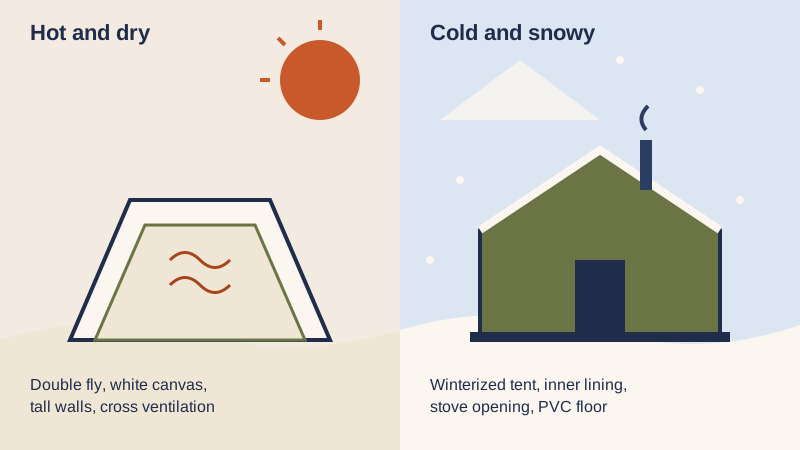
Heat is the main enemy. A double fly is strongly recommended because the shaded air gap lowers the temperature under the inner roof. Light colours such as natural white reflect sunlight better than dark ones. Tall walls (as on the UNHCR-pattern or African refugee tent) let hot air rise above head height, and roll-up windows allow cross ventilation. For regions with very strong sun, ask about high-temperature-resistant finishing.
Monsoon and humid regions
Waterproof and rot-proof finishes are essential where canvas stays damp for weeks. A PVC groundsheet and a raised sod cloth keep flood water and mud out. Olive green hides dirt better on long deployments.
Cold, high-altitude and winter regions
Choose the winterized tent, or a double-fly model with an inner lining and stove pipe opening. A PVC groundsheet is a must. Heavier 450 gsm canvas holds heat better and handles snow load more reliably than lighter grades.
Emergency deployment and airlift packing
In a disaster response, the speed of the first shipment matters as much as the tent itself. Our packing unit prepares relief tents so they travel efficiently and reach families intact.
- Specification and sample. You confirm model, fabric weight, colour and accessories. Samples can be made, usually shipping in about two weeks.
- Production. Lead time is usually 30–45 days from product approval, depending on quantity. Yarn doubling, weaving, dyeing and stitching all happen in our own units.
- Packing per tent. Each tent is packed as one unit (canvas, poles, pegs, ropes and bag or roll) and labelled so field teams can hand out complete kits without sorting.
- Mode of shipment. You choose charter flight, sea freight, container, truck or courier, and we handle the rest so goods reach the destination on the calculated schedule.
- Field pitching. Ridge tents can be pitched by two or three adults; larger frame tents need a small team.
For airlift, the bulk and weight of each kit decides how many tents fit on a pallet or in an aircraft hold. Folding canvas tightly, bundling poles separately and using compact bags all help. For sea or road, full containers are the most economical route, and we can advise on mixing tent models within one load. More detail is on our shipment page.
Ordering relief tents from Curiotex
New customers usually pay by sight L/C or 70% advance. Minimum order quantities apply and vary by model. If any tent arrives defective, it can be returned for repair or replacement. Raw materials are purchased locally in Pakistan, and twisting, weaving, dyeing and stitching are done in-house, which is how we keep quality consistent across large tenders.
To get a quotation, tell us the model, quantity, fabric weight, colour, accessories (inner lining, stove pipe opening, groundsheet type), destination and preferred shipping mode. Send it through our inquiry form, email info@curiotex.com, or call +92 317 8885522 and ask for Haji Ghulam Hasan. You are welcome to visit our Lahore office as well.
Refugee tents Pakistan: buyer questions
Which refugee tent models do you manufacture in Pakistan?
We make seven relief models: the Family Ridge Tent in single fly and double fly, a double fly single pole tent built to the widely used UNHCR family-tent pattern, a winterized tent, a hospital/store frame tent, an African refugee tent and a dispensary frame tent. Fabric ranges from 400 to 600 gsm cotton canvas depending on the model.
Are your tents UNHCR approved?
No. We do not claim UN or UNHCR approval or supplier status. Our single pole family tent is built to the widely used UNHCR family-tent pattern, with a 4 × 4 m inner tent and 4.5 × 4.5 m outer fly, so buyers can compare it directly against their tender specification.
What is the difference between single fly and double fly relief tents?
A single fly tent has one canvas layer and is the economical choice for mild weather or short stays. A double fly tent has a second outer roof with an air gap that keeps the interior cooler in sun and drier in rain. For long stays, monsoon areas or winter, double fly is the better investment.
How do you winterize a refugee tent?
Winterization combines an inner cotton lining to trap still air, a reinforced stove pipe opening in the roof so a heater can be vented safely, and a PVC groundsheet to block ground cold and damp. We build a dedicated winterized tent and also offer lining and stove openings on the double-fly ridge and UNHCR-pattern tents.
How many people can live in one family tent?
Our ridge tents are rated for 4, 6, 8 or 12 persons as sleeping capacity on floors of 8 to 24 m². For long stays, agencies often plan roughly 3.5 m² or more per person, so a 16 m² tent usually houses a family of five or six comfortably. Use this as approximate guidance and follow your programme standard.
What is the lead time for a large order of relief tents?
Production usually takes 30–45 days from product approval, depending on quantity and model. Samples can normally be shipped in around two weeks. For emergencies, contact us early with your quantity so we can plan fabric weaving and stitching capacity around your deadline.
Can refugee tents be shipped by air for an emergency?
Yes. Shipments can go by charter flight, sea, container, truck or courier. Each tent is packed as a complete kit with canvas, poles, pegs and bag, which suits airlift pallets. Shipping cost depends on mode, destination and consignment size; see our shipment page for details.
Which groundsheet should we choose?
PVC groundsheets are the most durable and fully waterproof, and come as standard with the winterized tent and the hospital/store frame tent. PE is lighter and cheaper for short deployments, and canvas groundsheets are available on some models. For flood-prone or cold sites we recommend PVC.
Can you change colour, size or fabric weight?
Yes. Standard colours are natural white and olive green, and we accept custom colours, sizes and fabric weights, as well as special finishes such as waterproof, rot-proof, termite-proof and high-temperature-resistant canvas. Send your drawing or tender specification through our inquiry form.
What payment terms apply to relief agencies and new buyers?
New customers usually pay by sight L/C or 70% advance. A minimum order quantity applies and varies by model. Defective goods may be returned for repair or replacement. Long-standing buyers can discuss terms directly with Haji Ghulam Hasan on +92 317 8885522.